
Circumstances
… long ago took me away from one of my favorite places I’ve lived. The place where I worked emergency services for 8 years. Where I lived up in the mountains in a log cabin. Where daily chains were necessary in winter; steep grades, 3 miles of narrow dirt road. A place where I was one of the oddballs – being more or less “normal”.
I’m now about 100 miles away on the other side of the mountains but I still keep in touch. There was an incident over there yesterday – a 15 mile, high speed chase along a twisty – but paved – canyon road with low visibility, rocks on one side, a creek on the other. And spike strips.
The sheriff’s office released a photo.
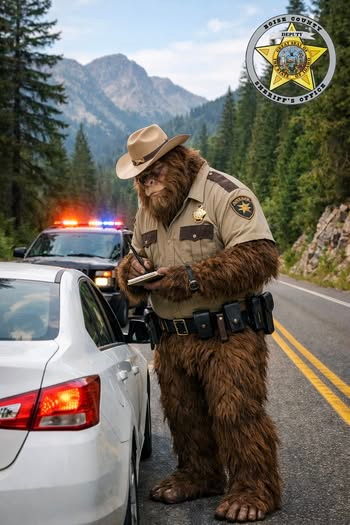
I see the deputy cleaned up for his photo …
A Keeper! Tanks.
That should be Thanks.
When I see a push like this….
=======================
These are not isolated cases. They represent the leading edge of what has become the dominant corporate playbook of early 2026: treat AI fluency as a performance metric, track it, and tie it to career advancement or, in the blunter formulations, to continued employment.
KPMG announced that AI usage would be graded in its 2026 performance review cycle.
Meta began evaluating employees on their “AI-driven impact” this year.
Amazon set an 80 percent weekly usage target for its internal AI coding tools and closely monitors adoption rates.
A survey of 1,295 U.S. business leaders conducted last year by AIResumeBuilder.com found that 58 percent of companies now require employees to use AI tools, with 10 percent of those reporting that they fire employees who refuse.
The logic driving this push is straightforward.
Companies spent billions deploying AI infrastructure and enterprise licenses throughout 2024 and 2025, and the return on that investment depends on actual usage.
A PwC survey found that just 10 to 12 percent of companies report seeing revenue or cost benefits from AI, while 56 percent say they have gotten nothing out of it.
When executives look at those numbers, the instinct is to conclude that the problem is adoption, not the tools, and that the solution is to push harder.
======================
Why does something need to be pushed?
Does a kid need to be force fed chocolate ice cream?
Will a drunk refuse a free drink?
Can a ghost turn it’s back on a porterhouse?
Would jethro klintin refuse a ride to E-Island?
If something is worth doing people will grab it with both hands won’t they?