
The Long Way ‘Round To Show A Picture Of Stoke’s Castle
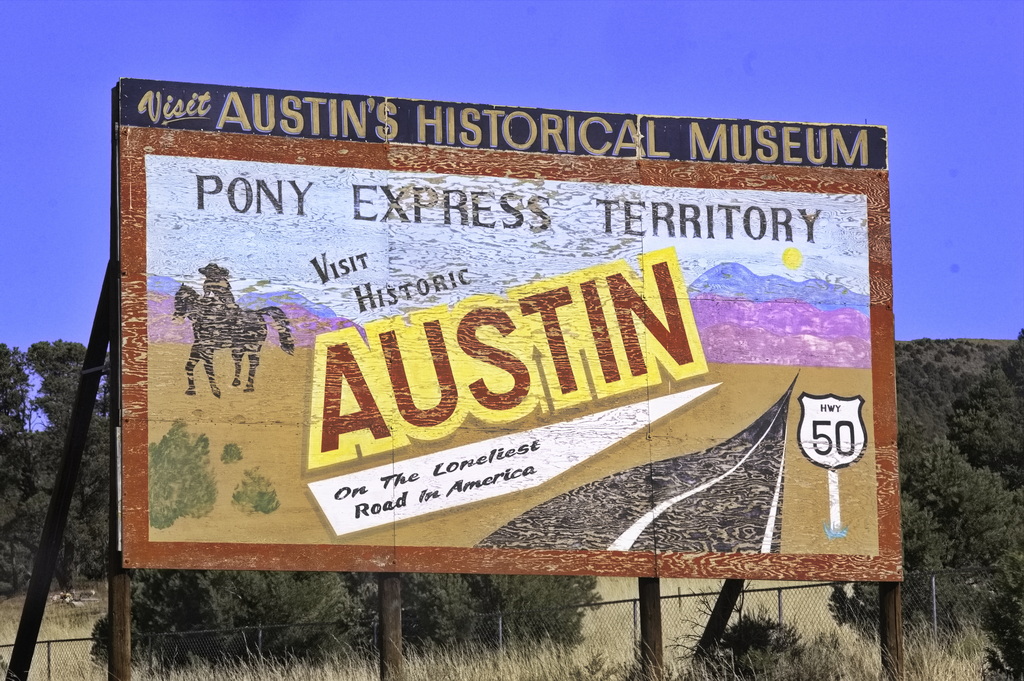
"Highway 50 is known for its stark, open landscapes, but there's not much on the road besides wide-open country. Fortunately, about halfway through the state, there's a charming mountain town with a wide range of activities and amenities for travelers. The Greater Austin Area Chamber of Commerce is proud to welcome you to Austin, NV."
A trail was blazed in 1851. By 1855, cattle were driven from Salt Lake to the gold fields of California through here. Being close to 300 miles and two weeks shorter than the Humboldt River route to California, by 1858, the army surveyed the route for use as a military road. In 1860, the Pony Express mail used this route and became obsolete in 1861 when the first transcontinental telegraph followed the route.
With the approaching war, the stage mail route was moved north to this now called "Central Route". Passengers, mail, and light freight could get from the Missouri River - usually St Joe or Westport (now Kansas City) - to California in 25 days or so; much faster than the 3-4 months it once took a wagon train to cover the distance.
Still, out here there was only the Reese River stage relay station, its employees, and .... nothing else except sagebrush and Indians.
Until spring 1862 when a former Pony Express rider living in the area discovered a quartz vein rich in silver. By summer, the Reese River mining district had been formed and by Jan 1863, thousands of hopefuls had arrived at what was then known as Reese River Station. Two camps were established, Clifton down on the flats, what would become Austin on the slopes. The people of Clifton, figuring they had it made, ran prices up for lots and goods; they also drove new-comers up the hill to Austin. By the end of 1863, Clifton had been abandoned and the town of Austin was established.
Although remote, the town sat on a major highway making it relatively easy to reach. It cost $63 to get to Sacramento from Reese River Station via Dayton and Virginia City - a 70-hour trip with meals costing $1 each.
By the summer of 1863, the town had 2000 residents, with bakeries, breweries, a hotel, a weekly newspaper, and four stamp mills - and a population of 7000 by the end of the year. Because of its location, Austin also became a staging point for those travelling to the new mines being discovered throughout central Nevada. At its peak, the population of the area exceeded 10,000.
In 1864, one of the town merchants, Reul Gridley, launched a fund-raising event that ended up raising over $250,000 by auctioning off a sack of flour. Gridley was a Democrat and made a bet with a Republican friend (that was possible then) where the loser would carry a 50lb sack of flour through town. Gridley lost the bet but made the payoff an event with the town band playing as he walked through town. It was suggested the sack be auctioned off to raise funds for the US Sanitary Commission. That raised $250 but the winner donated it back to be auctioned again. Virginia City heard of the event, invited Gridley to auction the sack in Virginia City, and eventually to San Francisco and back east cities. Mark Twain wrote of the event in "Roughing It". Gridley moved to Stockton in 1866 and died in 1870. His store still stands on the east edge of town right off US50.
In 1962, the TV show "Death Valley Days", season 11, episode 2 told the story as "The $275,000 Sack Of Flour"
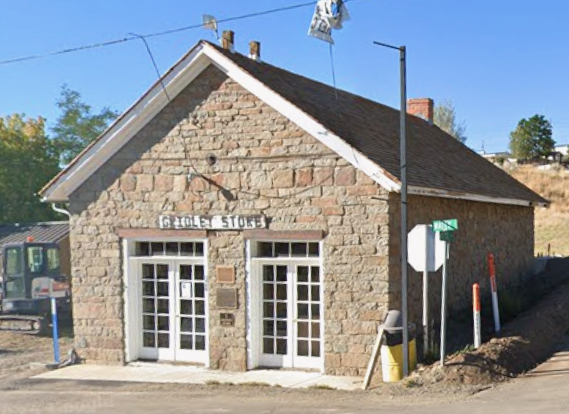
39.48953, -117.06296
Having become the county seat, Austin was incorporated as a city in 1864. Police and fire departments were established, buildings were built of brick, gas lighting became available, the newspaper became a daily issue. The mines were stable producers, a railroad was built north to the transcontinental line at Battle Mountain - times were good in Austin.
By 1887, most of the major mines had played out after $20M worth of silver had been produced
(figured at 1968 price of 91¢/oz. Silver is now priced at $60-70/oz)
By 1881, the town was dis-incorporated.
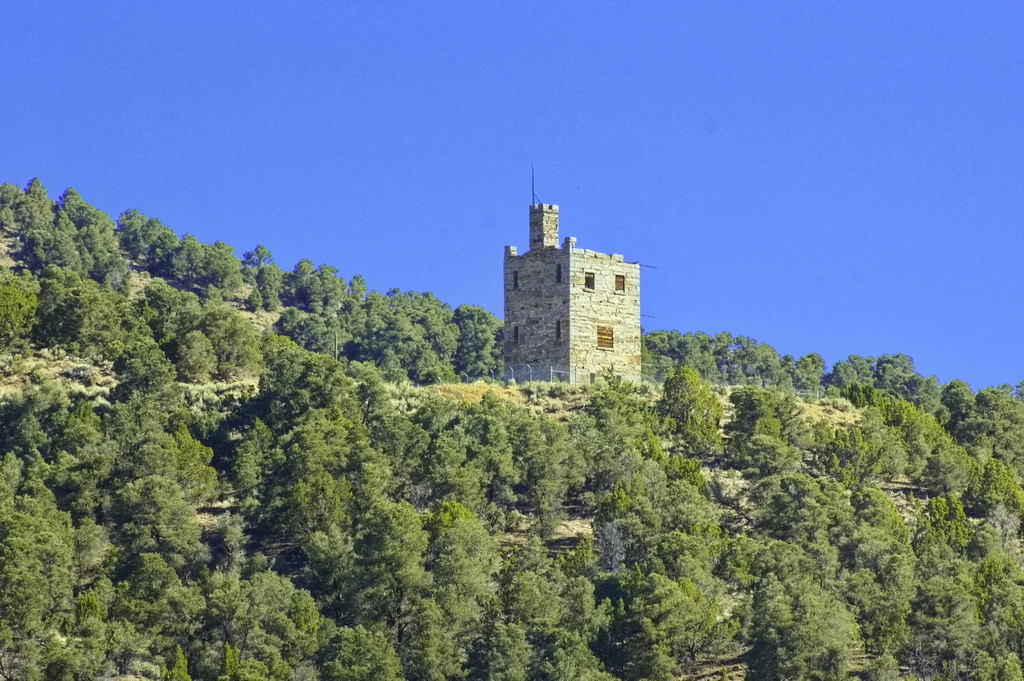
One of the major mine developers in the later years was Anson Stokes. He built a 3-story summer home modelled after a castle tower in Italy. Built on a hillside overlooking the vast Reese River Valley, constructed of hand-hewn granite blocks, each hoisted with manual winches, and fastened by wedging with clay mortar. the kitchen and dining room were on the first floor, living room on the second, with two bedrooms on the third. Each floor had a fireplace, the second and third floors had balconies.
The family spent a month in the home in summer 1897, a few days in fall 1897, came back in 1898 to sell their holdings and never returned. It sit abandoned (except probably by teenagers on nightly escapades) until 1956. It was sold again, listed as a Historical Place in 2013s; the owner died in 2018, and the castle is now owned by the Austin Historical Society.
US 50 runs through the town. Sitting at 6500 feet, it is no longer incorporated, it is no longer the county seat, and has a population of only about 170 people. Modern times have come to Austin though. There is now a gas station in town ... used to be when I was riding motorcycles along US 50, I had to plan for gas when running at night - there wasn't any available between Fallon and Ely - 260 miles. Long run on one tank of gas.
The "Loneliest Highway In America" isn't so lonely anymore.
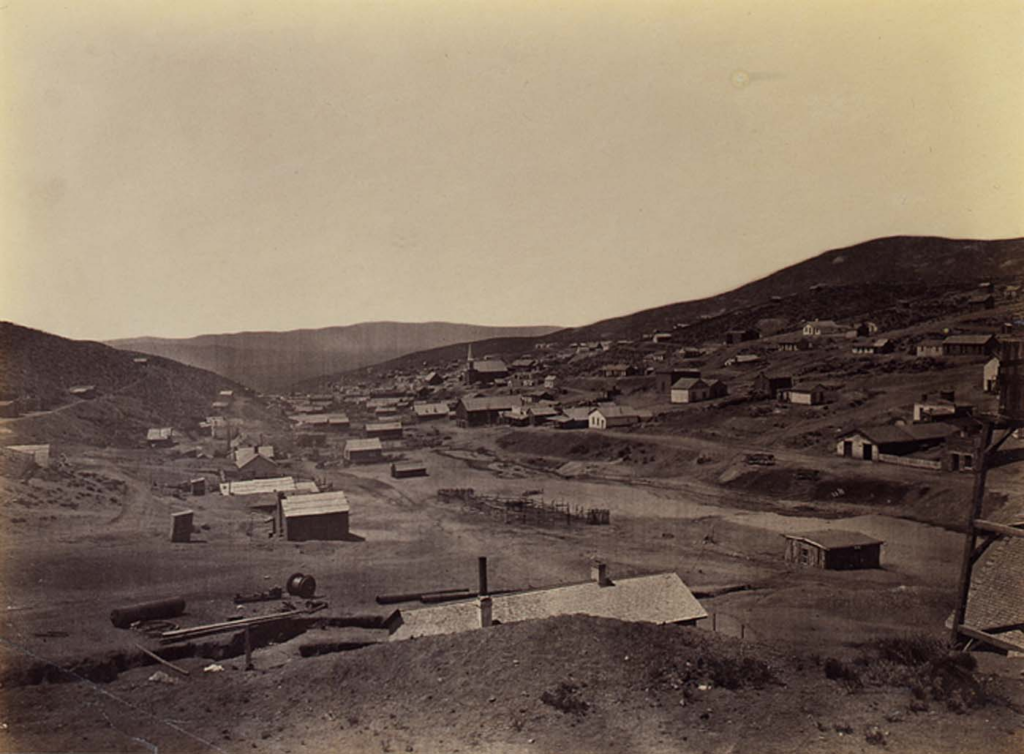
the church in center still exists