
The Engine House
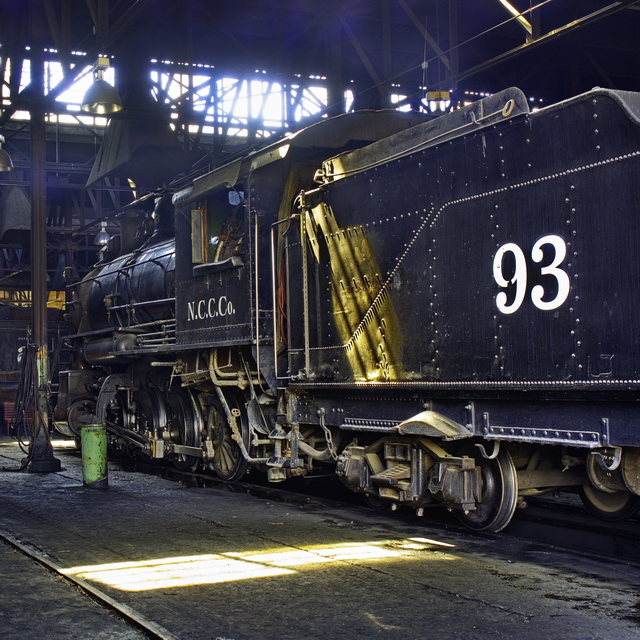
Along about the mid-90s, I was in a position to prepare a surprise for my father.
My buddy Dave & I were spending time looking for various ores in Nevada. I had developed a magic box and we were testing it out at different places. Now Dave is a professional “prospector”; he makes his living exploring potential ore zones suitable for mining development.
Myself? I stayed in a Holiday Inn Express so I could pretend I knew what I was doing. Over the years, though – wandering through places with professionals – I became an expert on leaverite ore and got pretty good at picking prime samples for assaying.
Y’all know I like old trains. Well, out there in east central Nevada sits Ely at the junction of US50, US93, and US6. Once upon a time, Ely was known for huge deposits of copper ore … though actually it was Ruth just to the west that had the good mines … and over a bit to the east lay McGill where the smelters were.
Ely became a place when a Pony Express station was established there in 1860 and later, a station on the Central Overland stage route (the western half from Salt Lake to Carson City of the Overland Stage run from St Joe to Salt Lake). Gold was discovered nearby in 1878 but didn’t come to much – copper was also discovered then but there was little interest in copper at the time – Ely was little more than a stage stop and post office.
Hamilton went bust and the state moved the county seat to Ely in the 1880s. The only other settlements in the county were dying off along with mine production; even having the post office qualified Ely as the only viable town to act as county seat. Businesses were attracted to the town – by 1890, there were 200 people living there.
Copper was becoming a metal of interest with the growth of electricity usage. Several of the nearby copper deposits were attracting investment; by 1902, half a million dollars of ore had been processed. By 1903, consolidation of the mining districts began with over 25 million tons of proven ore.
By 1905, the need for rail transportation led to the construction of the 140 mile long Nevada Northern Railroad, completed in 1906 and used to haul copper ore from the mines at Ruth through Ely to the smelters at McGill, then haul the processed metal to the major railroads up north at Shafter (Western Pacific) and Cobre (Southern Pacific).
Ely had become a boom town.
Until 1907 when a national financial panic hit the country when the mines mostly went bust.
Until 1908 when the smelters in nearby McGill were completed, leading a boom with increased production and lowered costs of the metal.
Until another slump after WWI led to the smaller mines once again shutting down.
Until the late 20s, production was up again, and by the 50s, Kennecott had control of most of the producing areas.
The copper deposits were large, the town was a focal point not only for mining but for ranches in the area. All transportation methods congregated in Ely, and by 1913, the Lincoln Highway passed through here – bringing more traffic and forming the basis for the modern US50 – at least in Nevada.
The mines played out for the most part, copper prices fell in the 70s, and Kennecott shut down operations in 1983.
Ely now has a population something in the neighborhood of 3 or 4 thousand and is still the only city in the county. Good place to get gas …. ’cause it’s the only place to get gas for miles and miles. And then more miles. And a few more for extra measure.
Ely is now mostly focused on ranching and tourism. It’ll be interesting to see if the mines start producing again with the recent increased prices of copper.
Along about the 1950s, the railroad started scrapping the aging steam engines. Legend has it that the crews hid Engine #40 – a 4-6-0 passenger engine built in 1910 – to keep her from the scrap yard. Maybe. Maybe not. In any case, #40 still exists, and still operates – the darling of the museum. It’s a handsome engine at that.
When mining shut down in 1983, so did rail operations. The whole kit and kaboodle was donated by Kennecott to the city of Ely to form a museum. The equipment, the rail yard, and structures – most dating to the early 1900s – were all left as is – in operating condition. It wasn’t worth the effort to Kennecott to even bother scrapping everything (and there was probably a healthy charitable tax deduction …)
Also kept, but stuffed and mounted, were the two remaining 2-8-0 freight engines #93 (blt 1909) and #81 (blt 1917) used for hauling ore. #81 was the last steam engine ordered by the railroad. In 1952, the railroad had acquired its first diesel engines and #81 was placed into storage. In 1960, it was given to a local museum and placed inoperable on one of the Ely streets as a display engine.
Engine #93, being older, had undergone extensive maintenance in 1949, was therefore in better condition than #81, so was kept operable as a backup engine. Diesel engines were taking over though so #93 mostly just sat. When the scrapman came to town in the mid-50s, #93 was held back from the torch “just in case” as the most recently upgraded engine. The engine was finally retired in 1956 after all the bugs of transitioning to diesel power had been worked out. A few years later, in 1961, #93 was also given to the museum and placed alongside #81. Stuffed and mounted, behind a cyclone fence, alongside US50 for all to ignore as they sped on past.
In 1990, both engines returned to the now museum railroad. By 1993, #93 had been restored and returned to active service, followed by #81 in 2021.
I had talked to my brother about his ability to get off work. I explained my plan and he was all for it.
So was his wife … that may be a different story.
It took a bit more convincing, but I talked Dad into catching a flight to Salt Lake from Cincinnati. I kind of hinted I’d meet him there but that I was working in the field so if I was late, just hang around – I’d catch up with him.
He didn’t know my brother was flying into Salt Lake as well but from Detroit and I needed Dad to hang around until brother’s plane got in.
He also didn’t know that brother was holding two tickets on the mail run to Ely.
So Dad’s doing whatever one does in an airport terminal, waiting and expecting to see me come through the entry doors.
Brother gets in, comes from the gate area instead of the entrance and confuses Dad a bit … who’s this calling out for him from inside the terminal? … until he realized just who was calling out for him.
“What are you doing here?“, he asks.
Brother didn’t explain – just told Dad “I have your ticket, we have a plane to catch“
Dad’s all confused now – to Ely?
It’s not a big plane. They were the only two passengers. It’s mostly a mail run.
Then they get to Ely. Where and what is an Ely??? Why am I in Ely?
Dave & I meet up with them at the Ely airport. Such as it is.
Dave & I have two pickups – not a bad idea when out where we were spending our time.
Easier to haul 4 people as well.
Brother goes with Dave.
Dad goes with me.
“What are we doing here?” he asks me.
“Nothing. Just seeing the sights“
It’s Ely – there are no sights.
Grab something for dinner, catch the motel for the night. Leaving Dad totally confused.
Brother’s in on it …
Next day:
“Now what?“, says Dad.
“Nothing. We’re just wandering around town and wanted you to enjoy the western air.“
Until it’s time for the railroad museum to open.
Dad likes trains. Probably where I got it from.
He bought me (him) a model railroad set for my 5th Christmas.
I blame him when the topic comes up.
So time comes, we wander down to the railroad yard.
It’s an open air museum with voluntary donations (or used to be. I don’t know about now).
So we wander around the yard for a bit until the inside portion opens.
Now he’s interested …
Then I send Dad and brother into this room inside the station.
I don’t go in, neither does Dave.
“Why aren’t you coming in?“, asks Dad.
“ ’cause this is for you“, says I.
(and for brother; he deserved it)
Dave’s amused by all this. We wander around for the ½ hour or so while Dad and brother are busy.
What Dad didn’t realize was that this museum allows you to operate the engine … for a fee of course.
But you have to take a “safety” course first.
I’m not sure he fully understood he was going to operate the engine until he got on board.
I’m talking to the lady in the souvenir stand talking about driving the engine.
“You don’t drive an engine, you operate it“, she tells me.
Being the smart-ass I’ve been known to be, I respond:
“But it’s an iron horse and you drive horses“
It’s been long enough – she probably doesn’t remember me if I go back …
Dad (and brother) get to operate a steam engine. It runs from Ely to Ruth and back … about a 20 mile run there and back.
Two runs – one for each of them. Pretty much fills the day.
I got to ride … with Dad.
Then it was brother’s turn … and Dave rode along.
Dad was left a bit speechless; even more so when Dave & I took them far out into the boonies and camped for the night.
Must have been near-on 200 head of wild horses in several herds in one of the valleys we went through.
To this day, Dad wonders how brother got the best – and warmest – sleeping bag.
Dad said he hadn’t been that cold since Korea.
The next day, Dave & I got them to the airport for their reverse trip.
Then we headed out to the field and got back to work.
Oh, by the way, the picture of #93 on top was taken right after the engine returned to the engine house and parked for the night after Dad and brother’s great adventure. There’s still a hint of smoke and steam in the photo.
Very nice story DT! Had me smiling the whole way. I didn’t realize it until I got to the end.
You’re such a gooood booyyy. *pat* *pat* *pat*.
Excellent!
High praise indeed. Thank you.
Well, train, train
Take me on out of this town
Train, train
Lord, take me on out of this town
Well, that woman I’m in love with
Lord, she’s Memphis bound
Well, leavin’ here
I’m just a raggedy hobo
Lord, I’m leaving here
I’m just a raggedy hobo
Well, that woman I’m in love with
Lord, she’s got to go
Well, goodbye, pretty mama
Get yourself a money man
Goodbye, pretty mama
Lord, get yourself a money man
You take that midnight train to Memphis
Lord, leave if you can
Oh, take that midnight train to Memphis
Lord, leave if you can
Oh, take that train, baby
Saw them and Grinderswitch and J Geils back when a concert ticket cost $7.
A fine thing you and your brother did for your father…..as well as yourselves. Good show!
“It’s Ely – there are no sights.”
Hmmmm.
I made a swing out through Nevada on US 50 a couple of years ago and stayed in Ely one night. Next morning I was headed west out of town when the cell phone rang, and it was the main orifice with a problem. Never one to duck a problem, I pulled over and in the midst of a long conversation about how to handle something, noticed that I’d pulled over in front of a cemetery on the other side of the street, with about two dozen vultures perched in trees above it, seemingly casting hungry gazes down at me. This was very appropriate to the conversation.
Then about an hour or so west of Ely, I ran into the annual Mormon cricket migration. Ye gods and little insects! I’d never heard of this phenomenon before but the only description that comes to mind is “biblical plague” and this was very appropriate to the phone conversation as well.
Area 51 and its alleged alien residents being out that direction, I was figuring they might be putting in an appearance next, but no.
Anyway, there might-maybe be a thing or two to see in and around Ely, depending on the circumstances.
Mormon crickets. Every so often, they get so thick roads close down and snowplows are used to clear them off. Worse than ice. They’re cannibalistic as well. Not every year though (whew!)
For someone interested in such things as I am, there’s lots to do and see around Ely. Other than the RR museum, not much in Ely.
Area 51 is well south of Ely … closer in to Vegas.
Heard on the radio later that trip that up at Elko they were having to use leaf blowers to keep doorways to businesses and hospital clear of the little critters. Part of my swing was back thru Tonopah and Rachel so I kinda skirted Area 51 to the north. The highway signs warning of low flying military aircraft were of interest, but I didn’t see any of those, either.
If you want to see low-flying military aircraft, some of the valleys north of Death Valley and east of US395 occasionally have some interesting vehicles in the air. Barely. There are places around that don’t exist with flights between them.