Fort Michilimackinac on the south shore (northern tip of the lower peninsula) was an early 1700s French, then British, fur-trading fort. The French had settled the area in the mid-1600s and the fort was a significant player in the French-Indian war of the 1750s. The British took over from the French in 1760 even though the residents of the region were mostly French. The area was also involved in Pontiac's War in the mid-1760s. In 1781, the British abandoned this fort and re-established another on Mackinac Island. The old fort was burned upon abandonment; a replica is now a state park just below the bridge (the "new" fort, Fort Mackinac, is now a museum on Mackinac Island). The British kept Fort Mackinac for 13 years after the Revolutionary War when it became American territory . This fort was a player in the War of 1812 and was kept as an active Army post until 1895.
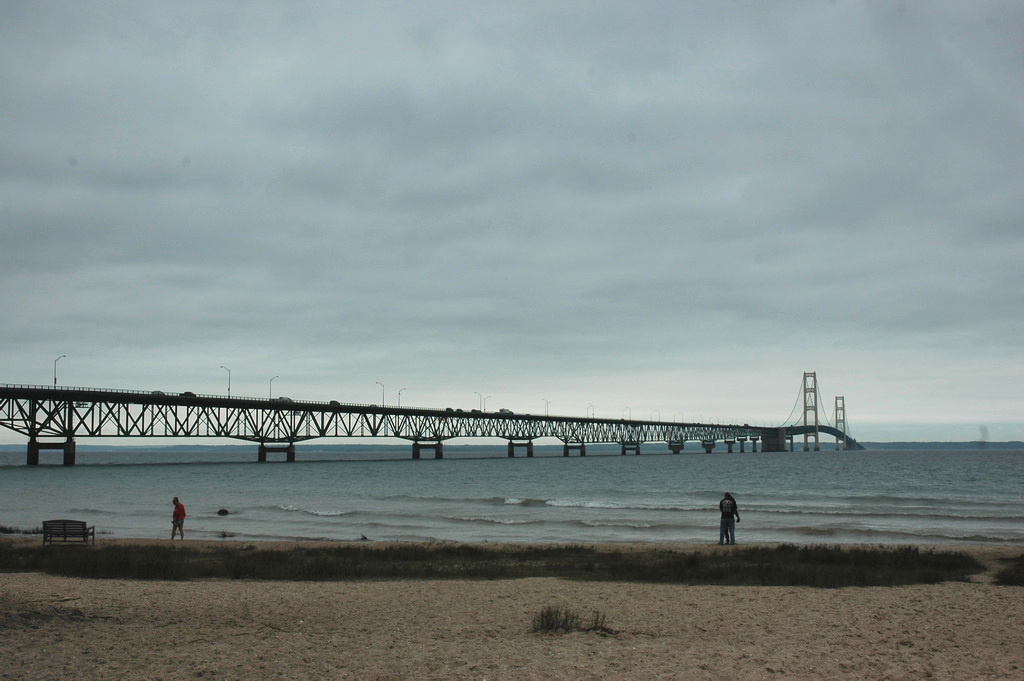
Opened in 1957, the Mac connects the Upper and Lower peninsulas of Michigan across the Mackinac Strait (which connect Lake Michigan to Lake Huron) via 4 lanes of I-75. Mackinaw City (settled 1673; pop about 800) is on the south side of the bridge; St Ignace (settled 1671; pop 2300) is on the north. I-75 extends another 50 miles and ends at Sault Ste Marie at the Canadian border. Mackinac Island is just to the east of St Ignace. Before the bridge was built, ferry service transported traffic across the Strait. Ferry service stopped the day the bridge opened.
The bridge - shoreline to shoreline - is 5 miles long and over 550 feet high (at the towers; the road is 200 feet above the water; the water is 250 feet deep at the bridge center) and is the longest suspension bridge (between anchorages) in the US. (Golden Gate is longer between towers; the Bay Bridge has an anchorage in the middle).
The bridge is a toll bridge ($4 for cars), one of three sections of I-75 that has tolls (one at the Canadian border, the other at the other end in Florida). The bridge is only open to pedestrians on Labor Day; it is not open to bicycles. Two of the lanes are closed to traffic on that day. Suicides are rare - perhaps a dozen in the life of the bridge. The bridge is not in a highly populated area.
The two outside lanes are paved; the inner two lanes are open grid. A 2ft median separates the two directions.
There is enough fear of crossing the bridge that an extra service is available to have a "driver's assistance" program in which someone will drive your car across for you. About 1,000 people per year request this service (of about 4 million crossings per year - deer hunting season!).
In 1959, an Air Force pilot flew his B-47 under the bridge - he was grounded for life.
The bridge occasionally closes due to high winds and icy conditions (ice falling from the cables).
Note: "Upper Michigan" is the northern part of the lower peninsula; the upper peninsula is the "U-P", inhabited by "Yoopers".
Sometimes I miss my home state ... not so much as I'd return though.
I once had a job in Sunnyvale, CA. I lived about 1 ½ miles from work ... and had to pass 8 traffic lights to get there. I'd have walked some of the time but there was a serious not-pedestrian friendly bridge over 101 that discouraged such thoughts. It would sometimes take ½ hour or more to get to work; traffic lights weren't synchronized and the back-ups to turn left sometimes took three light cycles to get through.
One of my work buddies lived in Santa Cruz and convinced me to consider looking for a place over there. I found a place outside the main city that looked pretty nice - room for a small garden (me? I dislike gardening ... but it appealed to me at that time) with a redwoods park across the street. I was a mile or so off the ocean and uphill from CA1; not in town directly, but close enough I'd spend time at the bookstore and the next-door coffee shop.
I liked Santa Cruz, I liked the Santa Cruz Mountains. If not for California being California, I might have stayed. And I might have died there; I left not long before the Loma Prieta quake and given the time of day, I'd have likely been at the bookstore or coffee shop when the quake hit - both buildings collapsed and were destroyed.
There was no internet or Starsux in those days. Coffee was good and books were cheap(er). The gay movement was present but not the alphabet soup types and certainly not in the "I'm offended, in your face" of today. More of a circus attitude ... but who likes clowns?
There's something - a smell - in the air under the redwoods that's almost addictive. Maybe it's the banana slugs.
As it turned out, Gary & Jody lived 4 doors up the street; purely by accident, I hadn't known where they lived before that other than somewhere near Santa Cruz. "Hey Gary, I found a place up on *** street". "That's where we live; which house?"
4 doors down ...
Now Gary & I worked in the same department at work so it made sense we'd go to work together. Hwy 17 was the route over the Santa Cruz mountains and into "Silicon Valley", work being almost on the bay.
It didn't take all that much longer to get to work from Santa Cruz than from my old place in Sunnyvale ... on good traffic days.
Hwy 17 is not a friendly road. Heavy traffic, windy twisty mountain road, California drivers.
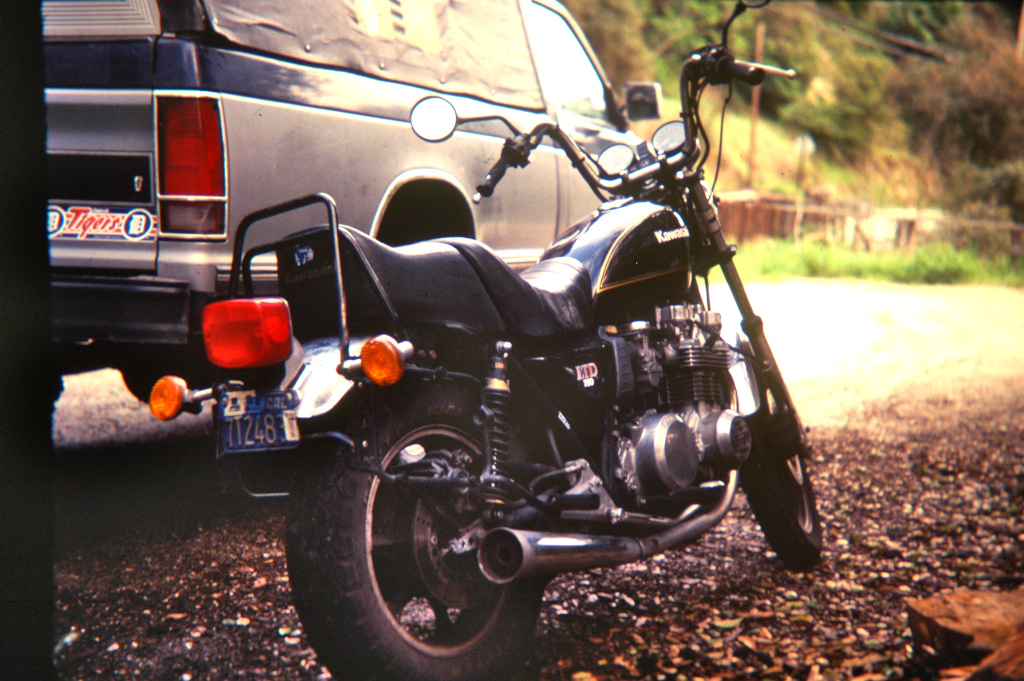
At the time, I had a mini-pickup (GMC S-15), Gary had a similar Toyota pickup, and we both had motorcycles. We'd switch off vehicles every week to go to work. Gary didn't like commuting in the pickups, I wasn't thrilled on the motorcycles.
I really liked that bike
One good thing: Work rules set hours adjusted for carpools. Gary & I qualified so we'd arrange to be at work by 6AM - leaving Santa Cruz by around 5AM, getting a bit ahead of the main rush over the hill. Better yet, it allowed us to leave at 2:30 and skip late afternoon meetings because we were in a carpool. Didn't matter that we were in the same department and missed the same meetings - "rules are rules".
As a side story - rules are rules - we worked in cubicle farms. Usually the cubicle walls were filled with pictures, cartoons, other such weirdness. One day the word came down that the only thing allowed to be put on cubicle walls had to be framed. Being the smart-ass I was/am, I took some manila folders and a sharpie, drew some curlicues resembling a frame, cut out the pieces and surrounded the junk precious artwork with those 1" wide strips of manila folder. To my surprise, it was deemed within the rules - no one had defined "frame".
I love corporate life ...
Anyway, while Gray & I lived the corporate life, Jody was a free-lance software developer.
Their marriage was beginning to fall apart. While we were friends, we weren't so close as for me to get into the why they were having problems.
A friend came down to visit from Oregon and apparently he and Jody sparked on each other. I asked my friend - a lady-killer by nature; bedroom eyes the girls just seemed to swoon over - to lay off Jody as I worked with Gary and considered them both friends. To my knowledge, he did back off. To my suspicion, perhaps not.
Time passed, work changed. My boss (and Gary's) died of brain cancer. The boss's boss had been with us for two years, got fed up with California, and transferred back to corporate HQ near DC - all within a couple of weeks.
I gave notice and left California, my job, and my motorcycle all the same day (haven't ridden a motorcycle since). Moved to Seattle. Hindsight suggests that was a bad idea but that's a different story.
Gary and a few others left the company not long after I did and all scattered to the winds. I lost touch with Gary and Jody. Last I had heard, Gary gave up his profession and became a professional photographer of motorcycle races. That was long, long ago; we weren't so close as to stay in touch.
_ _ _ _ _ _
Fast forward a few years. I was searching for "something" that I never found - work and life balance perhaps - and had lived in many places. Seattle hadn't worked out after two or three years, a job in Bozeman was a joke (never work for a man whose company is a hobby); I had moved (back) to Reno but had a far better opportunity outside Denver. All this in the space of 4 years. Owned two houses in that time ...
A semi-wife and I had broken up; she went back to Seattle, I stayed where I was. I had put her in an opportunity to fulfill a dream she had ... the reality of that dream destroyed it for her - she went back "home" and I never saw or heard from her again. I have no regrets for the break-up but I do wish I hadn't been the one to destroy her dream; better to have kept the dream than face the reality.
Jody got in touch with me. ??? She was still in California, Gary and her had divorced years ago, and she was in trouble to the point where I was her last hope. That sounded strange ... we were never what I'd call close and there was never a hint of a spark between us. Desperation indeed.
She wanted to come out and visit. She had to escape ... something ... she wasn't being clear about.
She came east by train. I picked her up in Glenwood Springs - she had gotten on near Oakland. Glenwood Springs was a 2-hour drive and an 8-hour train ride into Denver. Quicker to just drive over and get her; train got into Denver late and I didn't want to go into the city anyway.
Turns out Jody had turned into a hard-core meth addict. She was trying to escape herself when it came down to it and she had burned all her bridges to the point where she felt I was her last desperate hope. Me??? Girl, you ARE in bad shape. It had been something close to 5 years since I had seen or heard from or about her.
I'm a sucker for stray cats, I took her in. Meth addicts are usually in a death spiral; many if not most can never escape. I made sure Jody wasn't carrying - by going through every inch of her stuff. I locked her in when I went out. I slept with her at night to ease her shakes by hugging her close - no sex, no desire on either of our parts; I never felt any spark, she had whored herself out that I doubt she'd ever get that close to anyone again. Just she needed some human contact from somebody that wasn't using her. Aren't I a great guy? /sarc
It was not a pleasant experience on my part.
Putting it quite mildly, it was a rough three weeks but it seemed she had kicked it. She looked better and told me she felt better and it came time for her to move on (please, oh please). The experience used up every bit of care and sympathy I ever had for her. I last heard from her from Madison, Wisconsin. She profoundly thanked me for saving her life. I guess that was true but I never thought of it in those terms. Maybe I was a good guy ... but I truly, really never want to go through that again.
I saw her once more when I happened to pass through Madison. It seemed she was doing OK but she lived on the lower levels of society; a world I hope and pray I never fall to. Spent the night as no more than a place to crash; left the next day.
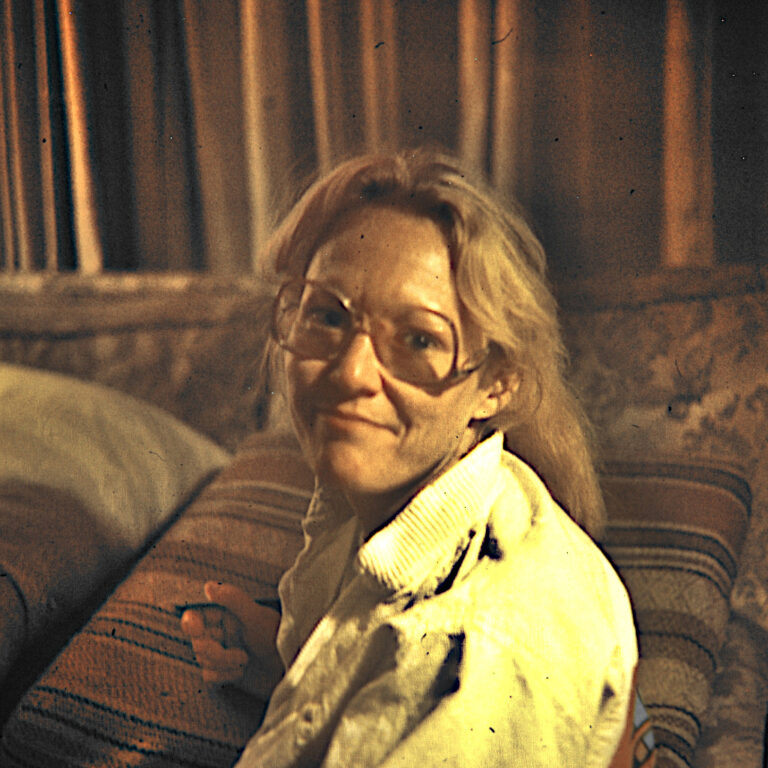
And Jody - for the most part - passed from my consciousness. Except for the recent passing thought from going over old pictures and finding the one above that led to this tale.
I do wish you well Jody. I hope you're still alive. May I never hear from or about you again.
Headline: "House Dems move to impeach Homeland Security Secretary Noem after Minneapolis shooting"
They have no platform, they have no ideas, they have no solutions. All they have is hate Trump and everyone involved with his administration. I'm getting tired of hearing "Impeach!". I want to hear "Guilty!"
But I never notice Republicans countering such activities ... (the translation of the word "Republican" is "closet Democrat").
It's going to be ugly when things finally break.
“What miserable drones and traitors have I nurtured and promoted in my household who let their lord be treated with such shameful contempt by a low-born cleric!” Henry II
“Will no one rid me of this troublesome priest?” that preceded the death of Thomas Becket, the Archbishop of Canterbury, in 1170.
Let's face it folks - we're caught in a quandary. The same people that are (supposedly) detaining and deporting the illegals are the figurative descendants of those who brought us Ruby Ridge and Waco.
What if all illegals are deported? What happens to all those Federal employees that now work for ICE? Even now with threats to shut down Dept of Ed, is anyone aware of massive firings of Federal employees?
Headline: "Idaho gov preaches 'common sense' after attorney makes argument in trans athlete SCOTUS case"
"Idaho has always led with common sense -- it’s why we were the first state in the nation to ban men from competing in women’s sports," Little posted to X. "I’m confident that same common sense will prevail as the Supreme Court reviews our law that set the precedent in defending girls and women." Gov Brad Little
Normally a not-allowed topic but a Supreme Court case is an exception.
Let's give Minnesota what their govt wants - independence from the Feds. After all, the Confederate States had that right - Lincoln over-rode the Constitution by implying the association of States was not voluntary. Let's correct that wrong.
Minnesota residents would no longer need to pay Federal income tax - or any other Federal fees as well. Furthermore, the state no longer needs to submit payments to the Federal government nor does it need to follow Federal law. All kinds of goody things by avoiding the Feds.
Of course, since Minnesota is now an independent sovereign state, all Federal payments to Minnesota stop as do all Federal benefits paid to Minnesota residents. All US passports are now null and void and border crossings are now subject to customs. Probably a bunch of other consequences I'm not thinking of right now.
A sample of some obscure - and maybe not obscure - tunes from my strange and off-the-wall collection.
Today's double selection: Klaus Schulze - "Euro Caravan" 2007
Off Klaus Schulze' 36th album, "Kontinuum"
Klaus Schulze (1947 - 2022) was one of the early German electronic music composers, having performed with Tangerine Dream, Ash Ra Tempel, and Cosmic Jokers - all of which are among my favorites. He ended up releasing more than 60 LPs, 90 if including compilations. He died of kidney disease just before his final album was released.
Euro Caravan is a 19 minute cut. It begins low and builds. I've often had it playing in the background without realizing it until it reaches my consciousness as it builds. It is not a loud piece but it builds over the entire time. Might be worth turning the volume up; it's quiet at the beginning but will not "roar" at you as it plays.