“I’m extremely pleased to announce that Gerard Van der Leun’s poetry book, Into the Smoke of the World and other poems, is ready for purchase. Poetry was very dear to Gerard’s heart, and this beautiful book features almost all of his poems that survived the Paradise fire, plus many full color photographs and cover artwork by wonderful pastel artist (and Van der Leun reader) Casey Klahn. Please go to the Vanderleunbooks.com website and order.” Paperback only, price $21.95 + S&H
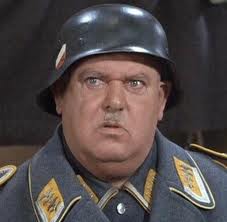
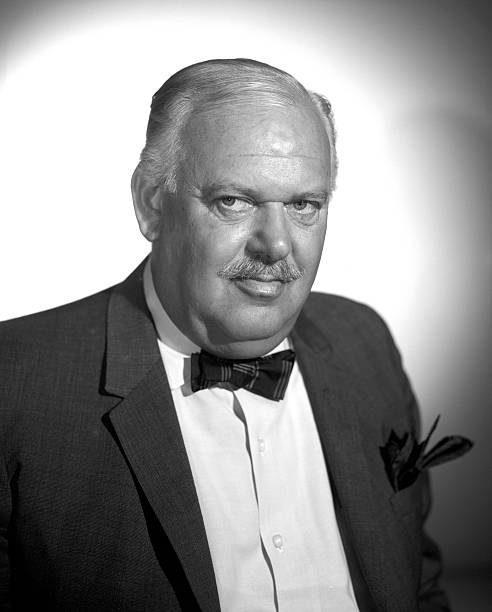
John Banner was born in Vienna on January 28, 1910 as Johann Banner. He died at Sofien Hospital in Vienna on January 28, 1973 of an abdominal hemorrhage. Although married for 30 years, he had no children. Like many of the actors and staff of Hogan’s Heroes, John Banner was Jewish.
Originally planning on studying law, he instead became interested in theatre. He was with an acting company in Switzerland when Hitler annexed Austria in 1938. Unable to return home, he emigrated to the US as a political refugee. He appeared in several films as a Nazi, often in uncredited roles – later finding the real Nazis had killed his entire family. In 1942, he enlisted in the US Army Air Force as a supply sergeant until war’s end.
He claimed it was his wife’s good cooking that caused him to gain 100 pounds.
He had appeared in over 70 TV shows such as Hazel, Mr Ed, Lucy, Red Skelton, Alias Smith & Jones, and The Partridge Family but it was Hogan’s Heroes (1965-1971) that made him known internationally: “I know nothing!“. He was one of six actors that appeared on every episode. After Hogan’s Heroes was cancelled, he starred in a much less successful show that was cancelled after 3 months. In 1972, he retired after a final appearance on The Partridge Family and moved to France, his wife’s native land. He died while visiting friends in Vienna where he is buried.
(I’d be happy to turn this site back over to you anytime you’d like …)
Three years now – it’s gone by fast
Here we are, three years Gerard’s been gone yet it seems his memory still lives on – perhaps this site helps. As such, maybe it’s time for a review of this site.
New American Digest went live on Dec 27, 2024, fumbling around in the dark so to speak. Neo told us American Digest would go dark on Jan 27, 2025, two years after Gerard’s death per his wishes; this site went live 1 month before then to make sure all was in order. Neo blessed us with an additional 3 months – American Digest went dark sometime on Apr 8.
By April 9th:
I didn’t start keeping site statistics right away … and no details until recently. For most of 2025, the site averaged about 50 viewers per day; recently The Feral Irishman mentioned this site on his very popular site (and soon to disappear I understand); the daily traffic now appears to be about 150 or so with a few days up around 300 or more. I don’t know if that’s unique visitors or not; it’s not really important – not entering a popularity contest.
A few of Gerard’s regulars have disappeared, some newcomers have arrived. That’s OK – I’m not Gerard, don’t try to be – I just intend to keep this blog open so that all you that visit here – mostly Gerard fans – can keep touch with each other … so I put up hopefully interesting pictures, a few stray stories, a bit of political commentary when something ticks me off, some stuff readers suggest I post, and other space fillers. I do miss Casey’s thoughts though; comments make the site.
I usually watch the site everyday but it’s not uncommon for me to queue up posts a few days in advance. To date there have been 774 posts and 4771 comments. The top 10 posts have been: Gerard’s Poetry (sticky), St Patrick’s Day , Another Damn Tranzie, By The Same Logic, Beware The Pendulum Swing, Something To Think About, Wow!,Jody, On A Kinder Note, and Some Don’t Believe. Looking at trends, it appears the recent post Sunday will make this list soon.
Only one “reader” has been banned and “Jody” is the only post for which I received a seriously negative comment (not the same person). Only one negative comment in a year? I haven’t looked to see if that person is still a reader or not. Hope so, but readers come and go.
For the week of Jan 19-25, there were 928 visitors. In the last 7 days, there have been 2135 views from the US, 153 from Singapore, 9 from Canada, 7 from Germany, a handful from Hong Kong, Brazil, Morocco, Iraq, and only 1 from about 10 other countries.
Will this site last? I really can’t say one way or another other than I have no plans at this time to shut it down. I suppose if daily views fall away there won’t be any point to continuing – but for now? I’m not seeking fame and fortune and I haven’t run out of photos.
Paradise is a state of mind … Blessings upon you all.
A sample of some obscure – and maybe not obscure – tunes from my strange and off-the-wall collection.
Today’s selection: Orange Swirl Society – The Fourth Pipe 1968
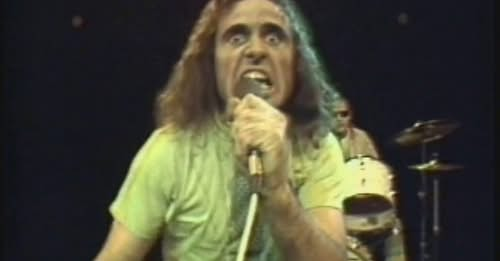
Pull out your bongs for this one. One of the earliest synthesizer pieces, the background of this group – and song – are lost in a haze of smoke-infested time. The best information I can find about the band or song is it was recorded by 17 or 18 yo Billy “Synth” Stump – himself shrouded in uncertainty – in or near Gettysburg PA … or maybe Harrisburg … or maybe Camp Hill.
According to one source, “Billy does vocals and plays the synth on this track [The Fourth Pipe] which was recorded during a flashback one spooky, foggy night at a long-gone studio, literally inches away from the battlefield at Gettysburg.”
“a notable figure in the world of underground music from Harrisburg, PA, was particularly known for his contributions to the punk and new wave scenes.“
Billy Synth Stump (1950?) – 2025)
Orange Swirl Society also did a cover of Sounds of Silence
(I made some sort of comment to ghostsniper about measuring distance in “tanks of gas”. Comes from being in the center of not much. So, it’s time to post this one ahead of schedule.
There’s a fair amount of babble around the wunderweb about “heading for the hills”. That’s ambiguous – I’ve lived in places where people thought a 2-acre lot was “out in the country”.
I like the idea of being able to shoot a rifle anywhere around my house and only have to worry about hitting trespassers. We all have our dreams … and a backhoe.
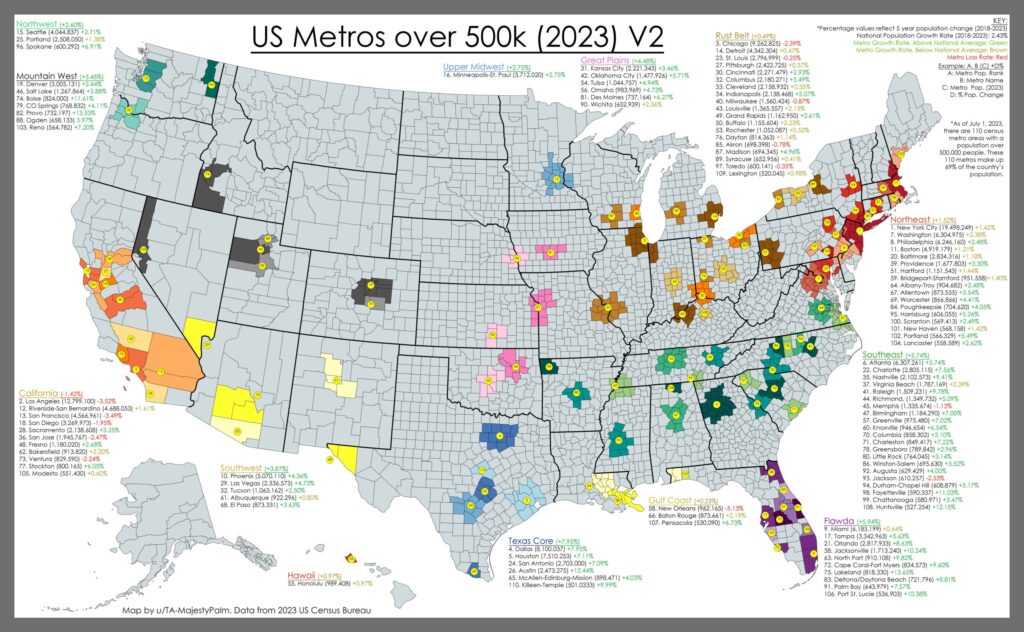
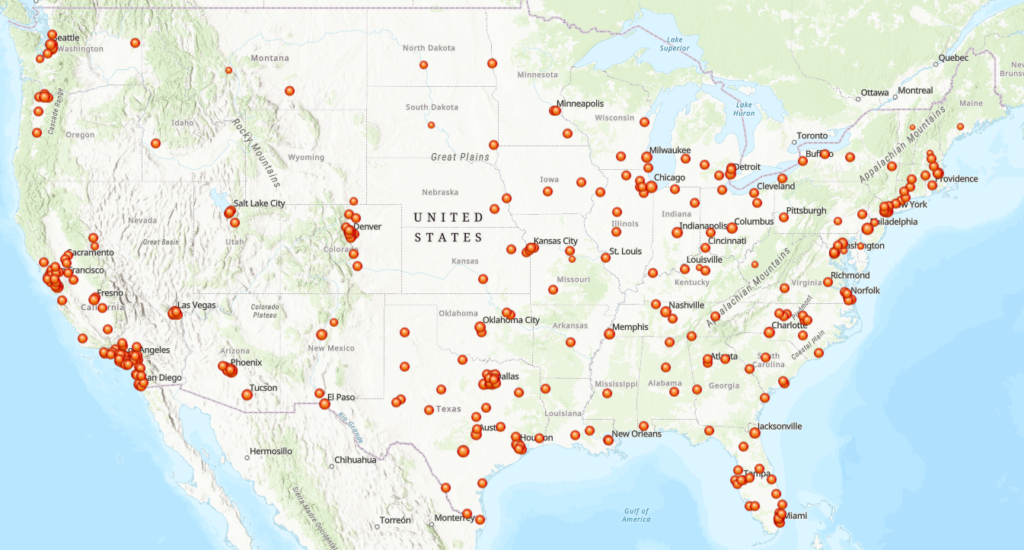
So I got curious the other day: what does a map of US metropolitan areas really look like? Let’s start with larger metropolitan areas. The following map shows the 111 metropolitan regions having over 500,000 population.
I was born in one of them; I’ve lived in 8 of them – by this definition. (many weren’t large enough to be on this list at the time I lived in them; the one I was born in was larger).
But looking more closely to those areas I’m familiar with, this map could be misleading. Take region 103: Reno (pop 564782). It was about ½ that size when I lived there but the point being is it shows all of Washoe County. Reno proper is just about where the yellow dot is; one gets a bit north of there, especially above Pyramid Lake, and northern Washoe County could be used as the definition of “empty” (except during the damned Burning Man event which tears up the southern end of Black Rock desert – another story.
Or the region I live now – on the NW extremes of region 74 (Boise, pop 824,000). It’s hard to see on this scale, but Owyhee County (below Boise’s yellow dot) is the extreme SW corner of the state. A 7900 square mile county, south of the Snake River, with a total population under 12,000 people concentrated in three “cities” (the largest has 2,600 people) and half a dozen communities – yet it’s considered part of the Boise metro area – even though the county seat is an hour away from Boise City … and is on the closer side of the county.
One could say the same of the area west of Salt Lake City/Ogden/Provo (region 46, 88, and 82, pop 2.6 mil). West of the I-15 corridor is hard desert.
I’m sure other regions – at least in the west – are similar.
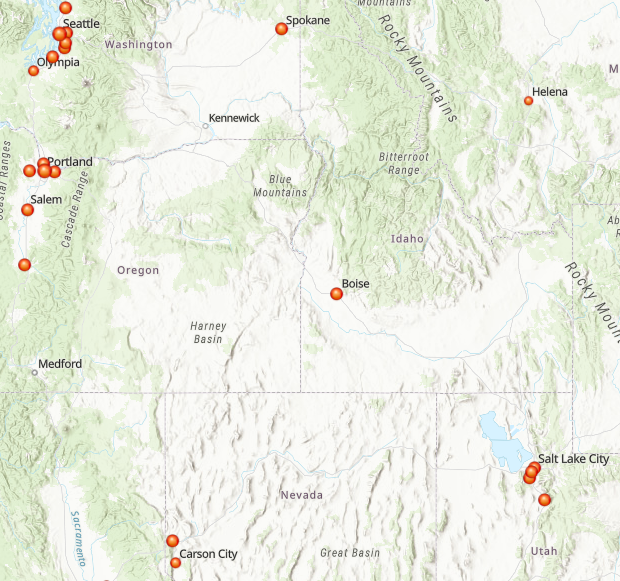
So let’s change the map: If I look for the distribution of cities of over 100,000, the map looks like this:
Boise is considered the most “remote” large city of the lower 48; two of the top 10 “remotest” areas of the lower 48 are not far from Boise (River of No Return Wilderness is #1, the Owyhee Canyonlands is #8)
“As the crow flies” Boise-Helena: 290 Boise- Salt Lake: 300 Boise-Reno: 470 Boise-Portland: 344 Boise-Seattle: 554 Boise-Spokane: 425
Biggest city in nowhere. Takes me an hour or so to get to Boise proper.
I’m going to church today. One of my neighbors does guest preaching and although I’m not their kind of Christian (and probably not anyone’s kind of Christian), I’m curious to hear what he has to say and how he says it.
Way back when, he and his wife would have been known as “Jesus Freaks” but they’re both too young for that era. But they are – or seem to be – sincere in their belief so I don’t push back when they try to save my soul. They mean well and they’re not pushy about it.
My soul is between me and any God that may exist; declaring a love eternal – or not – for Jesus isn’t going to make any difference. I’m headed for purgatory anyway; not good enough for Heaven, not bad enough for Hell. I suspect I’ll have lots of company.
Why do I suspect many of today’s belief’s come from the religious/political class efforts to keep control of the riff-raff? Perhaps a study of the Church and its activities over the past couple thousand years?
If you desire life ever-after … “Love your neighbor”, “turn the other cheek” … Sounds nice at first, but do you really want to live forever??? I mean, longer maybe, healthy, but forever?
Now, I don’t really want to dis that sentiment, but most Christians I know and have known, prefer the Old Testament god and use the “I believe! so my sins are forgiven” excuse to justify what they will.
But Jesus also said: “I come not to bring peace, but a sword.” The guy was a shit-stirrer: tossing tables of the bankers, dissing the religious leaders of the time, pissing off those in power; that’s the Jesus I can believe in – they do not execute passive beta males in that manner.
In any case, I want to hear my neighbor speak. I know my attending services will encourage them to see me “born again” but I was raised in a hillbilly Presbyterian offshoot church and came to be (inadvertently) leery of holy-rollers and particularly preachers. But they are good neighbors, I like them, and it won’t hurt to establish myself as a “good guy” for the coming times.
And when it comes down to it, I’d rather live in a Judea-Christian society than the apparent other alternatives and I will stand with those that do believe “When a strong manarmed keepeth his palace, his goods are in peace” (Luke 11:21)
– Anti-ICE Leftists Seize the Minneapolis-St. Paul Airport – CBP Involved Shooting in Minneapolis – Far-Left Minneapolis Mayor Jacob Frey Throws Gasoline on the Fire After Federal Agents Fatally Shoot Armed Man – Rep. Ilhan Omar Calls Fatal Shooting of Armed Suspect in Minneapolis an ‘Execution,’ Accuses Federal Agents of ‘Targeting Our Residents’ – Chaos Erupts in Minneapolis Following ICE Involved Shooting as Leftists Throw Rocks at ICE, Block Armored ICE Vehicle, Set Dumpster Ablaze in Organized Insurrection – ‘Looks Like a Situation Where an Individual Wanted to Do Maximum Damage and Massacre Law Enforcement’ – New Warrantless Home Entry ICE Policy Sets Up Constitutional Showdown – Minnesota Governor Tim Walz Rages Against Federal Agents After Fatal Shooting, Calls for White House to Pull ICE from the State – Ignores That Suspect Was Armed with a Gun – Minneapolis police declare ‘unlawful assembly’ after Border Patrol-involved shooting – Pennsylvania county gives ICE ‘taste of their own medicine’ and tries to ‘deport’ them – “Let Our ICE Patriots Do Their Job”: Trump Rages After Armed Suspect Shot By Border Patrol Dies – Judge Orders Release Of Minnesota Church Agitators Nekima Armstrong, Chauntyll Allen