
The Night They Drove Old Dixie Down
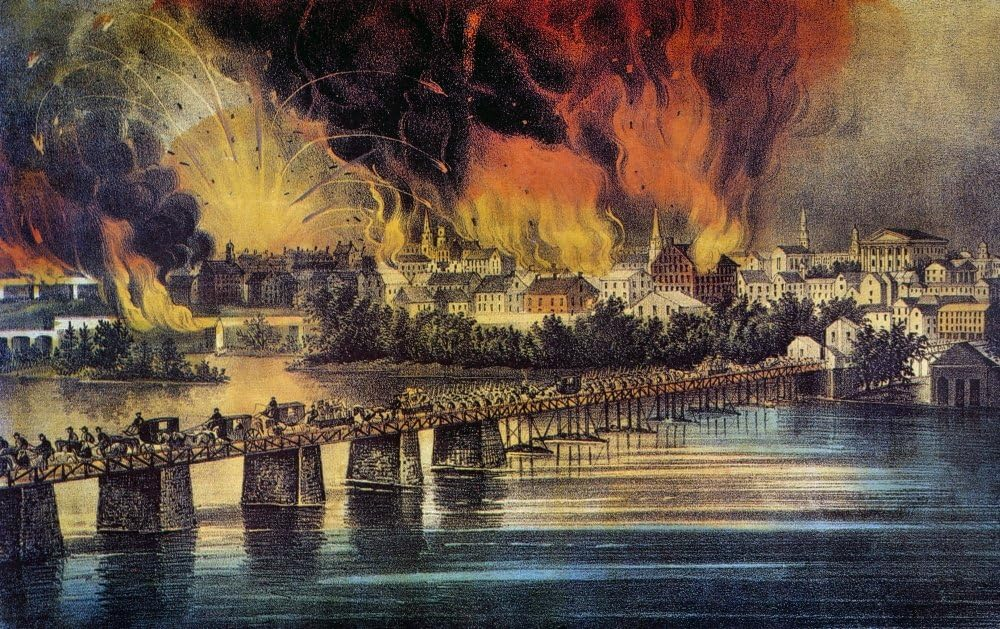
As the fall of Petersburg, VA became imminent, on Evacuation Sunday (April 2), President Davis, his Cabinet, and the Confederate defenders abandoned Richmond and fled south on the last open railroad line, the Richmond and Danville. Those that could left by way of the Mayo bridge before it too fell to the flames. By the morning of April 3, Richmond lay in ruins and the Yankees had come visiting.
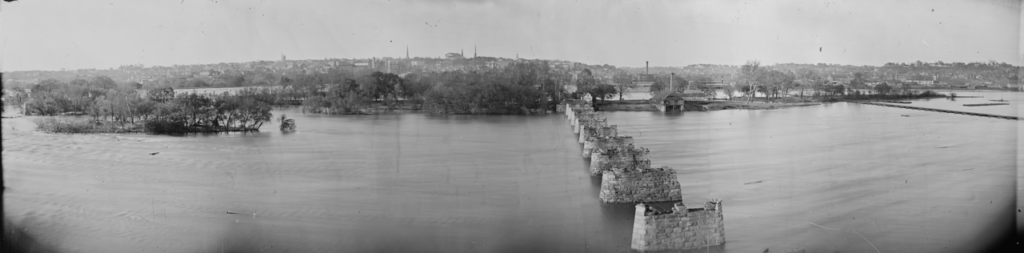
The Mayo Bridge – or its ancestors – is the oldest bridge in Richmond. The granddaddy was built in 1788. Floods and ice flows on the river kept destroying the bridge – with an exception to the norm in 1865; the bridge was rebuilt in 1814, 1816, 1823, 1865, 1870, 1877, 1882, and 1899. The current bridge was built in 1913 and is the only bridge in Richmond still subject to flooding. It is now known as the Mayo bridge, the 14th St bridge and US360.
I’m glad I got to visit Richmond before the woke ruined it.
The fall of Petersburg VA was, in my opinion, one of the pivotal moments in the war. Many scholars debate the reasons for the war with some saying it was slavery and some saying it was states rights. In the vain of slavery I often wonder why nothing is ever mentioned about white slavery and in particular the slavery associated with the Irish. Many will say the Irish were not slaves but indentured servants. I believe most never had the opportunity work their indentured status off because they were literally worked to death.
The last part of your comment answers the first part, and it was there all along. They lied to us back then and the lie to us still.
It requires gullibility and ignorance of pacific volume to swallow the notion that 600,000 white men died because of some negro’s that were legally considered only 3/5 human. There were negro soldiers in the confederacy and we are supposed to believe they too were fighting FOR slavery. It’s nothing short of astonishing that this gargantuan lie has lasted as long as it has. Almost as astonishing as the 6 mil in Germany mid 20th century. Come on man.
Interesting that you mentioned the 6 million. If it has not been erased from all ai format then you can view a copy of the headlines of the New York Times just as the ww1 as finishing that stated 6 million —-died. hmmmm. There is a lot more than is not said but someday someone may just release all the info on ww2.
Not too much mention of black slaveholders either. The first “legal” slave-owner under English rule was a black man (look up Anthony Johnson 1655)
In the early 1620s, African slave traders kidnapped the man who would later be known as Anthony Johnson in Portuguese Angola and sold him to Portuguese slavers, who named him António and sold him into the Atlantic slave trade.
A colonist in Virginia acquired António.
As an indentured servant, António worked for a merchant at the Virginia Company.
He was also received into the Roman Catholic Church.
More here:
https://en.wikipedia.org/wiki/Anthony_Johnson_(colonist)
CW remains complicated even today, mostly due to education, or the lack thereof, as more-or-less already mentioned, so I’ll let that go. But I would note both sides of my family tree had participants on both sides, and everybody involved suffered, many paying up with that last full measure, etc., so when I hear some mook rattle on about CW2 as something to look forward to, I just shake my head and write them off.
Now as to The Band’s song, I had a lot of respect for Joan Baez for yelling bullshit in the streets about what was going on with the Khmer Rouge while nearly all the other peaceniks ignored it, but she sucked as an interpretive lyricist. Virgil served on the Danville train, Joan, and it was Stoneman’s cavalry, among other inconveniences. What the hell, Joan, do try to keep up, please.
On the other hand, RE Lee never went to Tennessee that I’ve found.
One half my family was in Canada at the time; the other half had participants on both sides. My g-gdad was with the (union) state cavalry; his brother was on the other side, I believe regular army. Neither were officers although gdad’s father-in-law was a Major in RA. (funny thing: FIL’s g’gdaughter insists he was Confederate even though his tombstone distinctly states his rank, unit, and membership in GAR. Gonna believe what you want to believe)
G’gad only left the state once to participate in Saltville I. Family papers and bibles from the era tell me they weren’t so much pro-union as ticked off the Confederates broke state neutrality (and Morgan burned their town and farms). Family voted Breckenridge in 1860; McClellan in ’64.
At local level, it was so mixed that violence in the local area continued until about 1880.
I find I tend to sympathize with the South though it’s hard to pin down why. Probably because I believe Lincoln pushed an unnecessary and illegal war and I believe the States did have the right to leave the (voluntary) union. Most southerners fought to protect their homeland, not to preserve slavery – at least from the journals and such I’ve read. Slavery wouldn’t have lasted much longer even without the war; didn’t make financial sense … and finance is the reason for most everything.
Those wanting CW2 are nuts – a CW2 would make CW1 look like a casual schoolyard fight.
Never cared too much for Baez.
The Constitution of 1789 did not have provisions for leaving. That means that if a State wanted to leave, it could make clear its unwavering intentions and work it out over time peaceably, or just flounce outta there. The Southern States decided that by flouncing they could take immediate possession of all the property of the United States. That’s now how it works. If you want possession of somebody else’s property there are two choices: pay for it or take/steal it. When the Confederates made it clear that they were going to take immediate possession of all Federal property by force and not pay for it, what was the United States supposed to do: walk away to prevent bloodshed, or defend its rights? It’s a quandary as old as life itself. The hot-headed Confederates chose … poorly. Once the path of war is chosen, a lotta people have to die before the survivors decide okay, enough.
Worthy of a discussion pro and con but an on-line forum isn’t really the proper place. Too easy to turn from a discussion to a rant and nuances of conversation are missed.
Foundation for: The American Revolution itself was a secession movement enshrined as “That whenever any Form of Government becomes destructive of these ends, it is the Right of the People to alter or to abolish it, and to institute new Government, laying its foundation on such principles and organizing its powers in such form, as to them shall seem most likely to effect their Safety and Happiness”
The question: “Was the Republic a unified nation in which the individual states had merged their sovereign rights and identities forever, or was it a federation of sovereign states joined together for specific purposes from which they could withdraw at any time?”
There are/were strong arguments for both sides of the issue.
Until the 1860s permanently redefined several aspects of “America”, I believe the latter was the original intent. Up until that time, it was usually “these united States” and a strong 10th Amendment (which in itself explained the issue of where and where not slavery could exist. A superior Federal govt could have just stated it legal or illegal nation-wide)
Might makes right. Had the Confederates won by force of arms …
Of course, they didn’t and winners write the history.
Nor did I. Baez has always reeked of sanctimony. Maybe it’s just me.
For what it’s worth, Tom Kratman urges those who want to have opinions about the civil war to read (quoting from my notes) “Allan Nevins’s monumental eight volume series on the American Civil War and what caused it.”
Nevins’ “Ordeal of the Union” should be balanced with Foote’s “The Civil War: A Narrative“. Bruce Canton also wrote several significant studies regarding the war and its times.
Robbie kinda nailed it for being a Canadian….