
Pogonip – The “White Death”
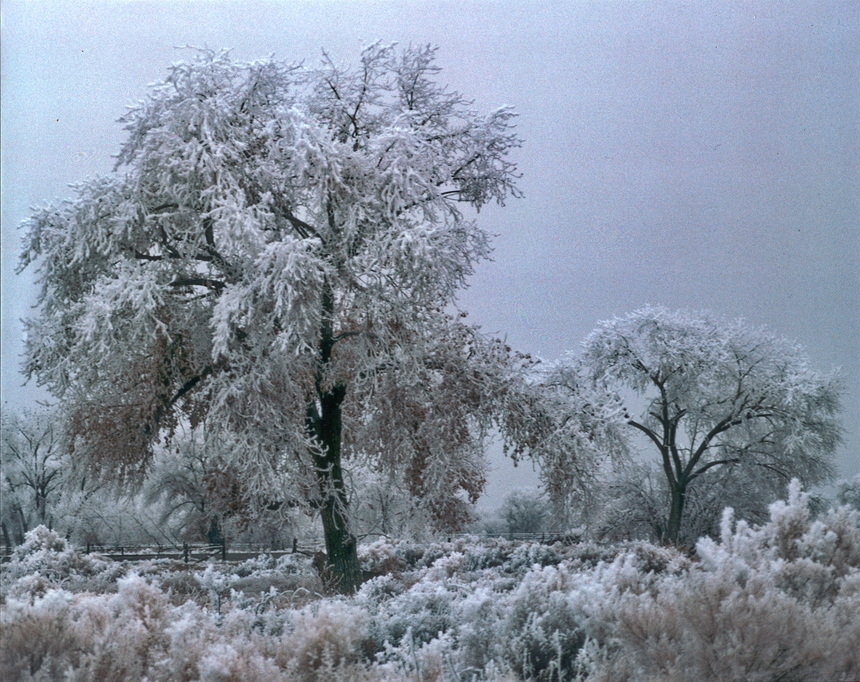
When conditions are just right – very cold and very still air – a dense fog can form long, needle-like crystals of rime (not ice); the super-cooled water remains liquid below the usual freezing point and doesn’t freeze until the droplets contact a solid surface. “Rime” is similar to that white stuff that needed to be cleared out of older freezers. Conditions for a pogonip may only last hours but may last for days.
Relatively common in western Nevada, the local Paiute lived in sagebrush huts and feared the coming of the pogonip. Breathing the frozen air would cause sore throats at best, a difficulty in breathing, and a ripe environment for pneumonia – the white death.
This photo was taken outside Fernley, Nevada about this time of year; the crystals on the trees were 2″ and longer in length.
It’s a good idea to wear a mask when outside for any length of time under these conditions.
One might speculate as to whether DT wore a mask when wandering around this copse …
Supposedly snow today. About 28 degrees right now.
I used to fly a plane in the MD-80 series, which are basically stretched versions of the old DC-9. In fact, my pilot license shows that I am qualified on the DC-9, when I have never set foot in the cockpit of one.
I say that because rime icing was a real threat to the MD-80s. The typical scenario that we’d see rime icing was after the plane had landed. The fuel in the wings was very cold, and when sitting at a gate, the ice would develop on the wings, even on a clear day. You are familiar with this phenomenon if you have ever taken a beer mug out of a freezer.
We were allowed to have some rime ice on the bottom of the wings (no more than 1/8″, if memory serves), but the upper surfaces had to be completely clear. My airline’s wings were painted and the ice can sometimes form as a clear surface. Depending on the time of day and the lighting, the icing could sometimes be very hard to see. We had speciality ladders which allowed a pilot to run a 10′ PVC pole across the upper surface to see if ice existed.
And so there we’d be, on a 50-55° clear blue sky day, having to de-ice the wings. Many (most?) passengers probably thought that we were nuts or deliberately slowing the operation down. [Why would I do that? Do I get paid more if we were late?]
Airframe, wing and engine icing can be a very dangerous thing. Improper de-icing procedures is what brought down Palm 90.
Just read that Palm90 thing. jeez
That pilot effed up from several diff angles.
Looks like he had been a problem for a couple years.
The part that got me though was his decision to take off because “The pilot apparently decided not to return to the gate for reapplication of deicing, fearing that the flight’s departure would be even further delayed.”
He risked the lives of a lot of people because he didn’t want to further delay the flight. My question is, why was a delayed flight so crucial to him? Would delaying the flight further have reflected poorly on him some how?
Also, and the pilot may have not known this at the time, fraudulent de-icing methods were applied which may have contributed to the whole thing.
I gotta wonder, do pilots become comfortable in their role to where the importance and severity of their job is taken less seriously?
I won’t speak for everyone, but asking yourself if what you’re doing is the best possible course is something that I always did.
That being said, there can be some trivial reasons why guys do things the way they do. That Palm 90 Captain might have been reluctant to delay for a second de-icing because he had a child’s recital or an anniversary dinner later that evening (just speculating here).
Also, the industry evolves as it goes. After Palm 90, we reinforced anti- and de-icing procedures. They began a concept of “holdover time”…..a time after which your previous de- icing is no longer valid. After years when we were delaying flights for de-icing, they changed which fuel tanks we used first, so as to minimize that spring and summer ice formation. After the Colgan 3407 accident, which the NTSB assigned pilot fatigue as a contributing factor, the FAA made fairly complex changes to duty time and rest rules…the simplified version being that domestic crews were required to have “8 hours behind the door” in a hotel. You didn’t have to sleep, but you had to have the opportunity to sleep.