↓
 

The New American Digest

For Followers of Gerard Van der Leun's Fine Work

  • About American Digest
  • About New American Digest
  • “The Name In The Stone”
  • Remembering Gerard Van der Leun
    • from the website: Through the Looking Glass
    • from the website: Barnhardt
    • from the website: Neo’s Blog
  • Articles
    • The Overland Stage
      • The Holladay Overland Stage: 1 – The Central Route
      • The Overland Stage – 2 Company Operations
      • The Overland Stage – 3 Exploring The Route – An Overview
      • The Overland Stage: 4 – South Platte/Julesburg/Ft Sedgwick
        • Jack Slade
      • The Overland Stage: 5 – Julesburg to Junction Station (aka Ft Morgan)
      • The Overland Stage: 6 – Junction Station to Latham
      • The Overland Stage: 7 – Latham Crossing to Fort Collins
      • The Overland Stage: 8 – LaPorte to Virginia Dale
      • The Overland Stage: 9 – Virginia Dale to Cooper Creek
      • The Overland Stage: 10 – Cooper Creek to Pass Creek
        • Fletcher Family
      • The Overland Stage: 11 – Pass Creek to Bridger Station
      • The Overland Stage: 12 – Bridger Pass to Duck Lake
      • The Overland Stage: 13 – Duck Lake to LaClede
      • The Overland Stage: 14 – LaClede to Almond
      • The Overland Stage: 15 – Almond to Rock Springs
      • The Overland Stage: 16 – Rock Springs to Fort Bridger
      • The Overland Stage: 17 – Fort Bridger to Weber Station

I find I don’t wish to explore new lands, but to explore again those I have already passed through, trying to see what I’d missed in the first hectic rush … Gerard Van der Leun

Home→Published 2025 → November → 11

Daily Archives: November 11, 2025

The Zippo Lighter

The New American Digest Posted on November 11, 2025 by G706November 10, 2025

submitted by G706

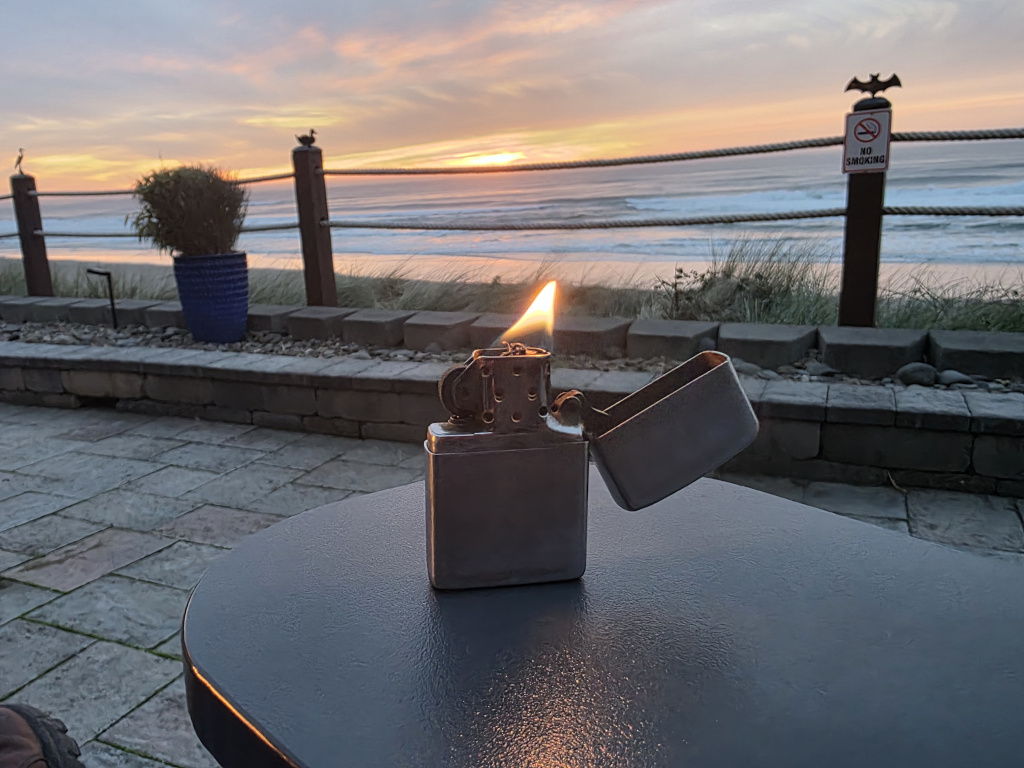
I have been carrying a Zippo lighter in my pocket for 4 years now, even though I don’t smoke. I carry it to honor a memory.

Uncle Rudy was not really my uncle, he was married to my dad’s first cousin, but when I was a child every adult who was familiar enough to not need to be addressed as Mister or Mrs. was referred to as Uncle or Aunt out of respect.

I remember him as a friendly, solid man, a sharp mechanic who worked at the local car dealer and played trombone in the band at the First Baptist Church. I know he served in the Pacific during World War 2 and had some health issues from that time. He died in a car accident when he was only 58.

Aunt Irene played the piano at the Baptist church. She never remarried and lived to be 96 dying in 2021. That summer her family had an estate sale at her farm. I was looking through the tables of knickknacks and stuff and saw the Zippo laying there among the bits of jewelry. I picked it up and paid the dollar price, took it home and replace the flint and filled it.

I like to think Uncle Rudy carried it during the war, but as far as I could know he never smoked. I looked up the serial number, it was made in 1966 so it was probably just for starting fires. Doesn’t matter to me, it’s a reminder of my neighbors and relatives of my father’s generation that served in Europe and the Pacific. The ones who came back and fought the demons of war silently or carried the wounds of battle and those that never came back.
Continue reading →
Posted in Uncategorized | 15 Replies

Armistice Day – A Tale Of War

The New American Digest Posted on November 11, 2025 by DTNovember 9, 2025

I recently came across a document written in 1968 by a Canadian WWI bomber pilot. The document describes his last flight entitled "My Last Bombing Raid". I thought it might be of interest on this Armistice Day.

The document is transcribed as written except for the addition of pictures.

My Last Bombing Raid

In World War I the British Air Force consisted of the Royal Naval Air Service and its Army counterpart, the Royal Flying Corps. There was no Canadian Air Force, but early in 1916 the Royal Flying Corps established a branch in Canada. A ground school was opened at the University of Toronto and later airdromes were erected at several locations in Ontario.

In 1916, I joined the ground school and after preliminary training in Canada was transferred to Salisbury Plains in England where I graduated on De Havilland 4's (DH4's). After finishing aerial gunnery at Turnberry Scotland, I went to France and was posted to Number 27 Squadron.

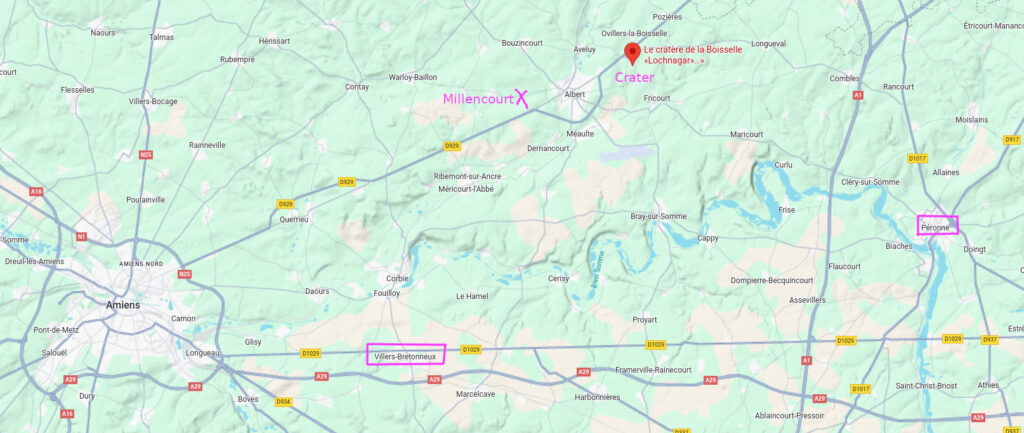
Our airdrome was situated at Vilers-Brettoneux, a small village on the Amiens-Perrone Road, about 4 miles east of Amiens and twenty miles from Perrone.

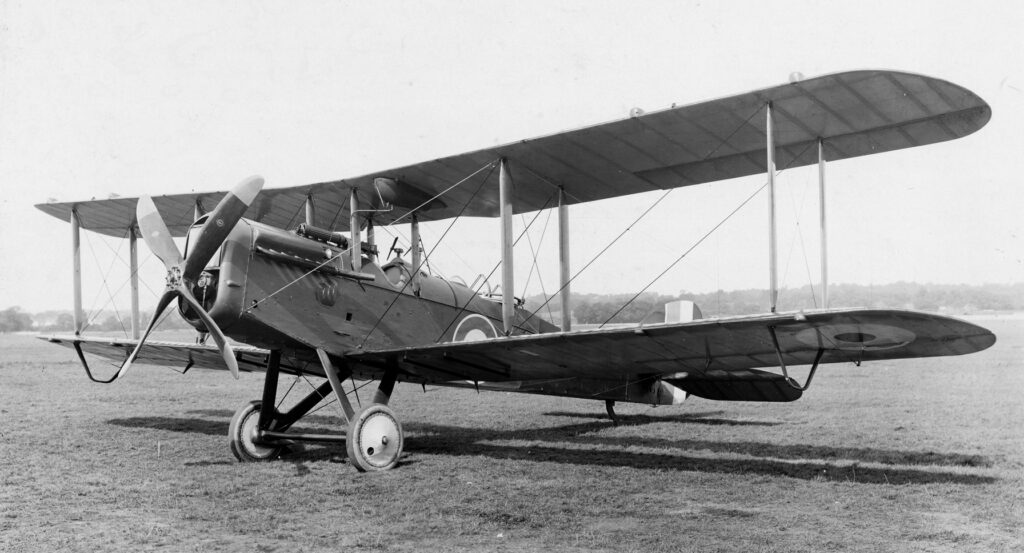
The 27th, a DH4 long-distance bombing squadron, was equipped with Beardmore-Halford-Pulinger engines (B.H.P.'s). The DH4 was a biplane with the pilot's seat beneath the upper wing between the engine and main gas tanks. A Vickers machine gun was mounted on the cowling and by means of a special gear was able to fire between the blades of the rotating propeller.

A small gravity tank was attached to the upper wing near the pilot's head. This tank was used for starting the engine and taking off, until the pressure in the main tanks had increased sufficiently to supply the carburetor. The observer's seat was in the rear of the fuel tanks.

Attached to this cockpit was a scarf mounting supporting one or two Lewis guns. As the pilot was just behind the engine, he was usually quite comfortable, but the observer was very much in the open and exposed to low temperatures. He was readily recognized around the mess table as the tip of his nose was scarred from repeated frost bite

De Havilland DH-4

The average speed of the DH4 was 125 miles per hour, and it carried enough fuel to remain in the air about 5 hours. Each squadron had one airplane equipped with a special carburetor and oxygen for the pilot and observer. This machine could climb to 24,000 feet and the day before the raid would take pictures of the next day's target. There was no danger from attack as the enemy was unable to reach this altitude.

Our targets were primarily railroad junctions, troop concentrations and ammunition dumps. Ordinarily twelve machines took part in a raid, each plane taking off separately. They would then climb to 17,000 feet over the rendezvous previously decided upon. In the case of 27 Squadron, this was usually Perrone. It took about one hour to reach this altitude and when all the machines had arrived they would take up formation and proceed over the front line on their way to the target. Each plane carried eight, twenty-five pound bombs, four on the bottom of each lower wing.

When twelve DH4's were in close formation, there were 12 machine guns firing forward and as many as twenty-four to the rear. The Germans learned to respect this fire power; however, if the formation were broken up or an individual machine became separated from the rest of the squadron, the heavy DH4 bomber was no match for the faster, easily maneuverable German fighter.

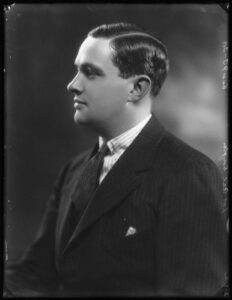
In the spring of 1918 the average tour of active duty for a pilot in France lasted six weeks. usually the same pilot and observer continued to fly together. About the middle of March, a new observer was posted to my machine. He was Lord Cecil Douglas, a son of the Marquis of Queensbury of the Queensbury family of boxing rule fame. He was twenty years of age and well qualified to carry on the enviable tradition established by the upper class of his generation in fighting for their country.

Lord Cecil Douglas
August 2 1924

On March the 21st the Germans attacked the British sector of the front line and aerial activity became markedly increased. Bombing raids were carried out once or twice daily. On this date the squadron commander's machine was being overhauled and the plane I had been flying transferred to him. I was given "F" which we all recognized as a "lemon".

[Hm-m-m... was someone in the doghouse with the squadron commander?]

On our first day in "F", Douglas and I started on a raid to Busigny but were forced to return because of engine trouble. The next day we were scheduled to bomb Le Cateu. This time an oil pipe burst and we had to return. This was repaired, and on March 23rd we started again, but the pressure pumps failed and we were unable to continue. On Sunday, March 24t, we were to bomb Aulnoy. This turned out to be our last bombing raid.

We succeeded in reaching an altitude of 17,000 feet over Perrone but it was evident the engine was not running well. I discussed with Douglas the advisability of returning to the airdrome. Because we had been forced to turn back on the proceeding three days, we were especially anxious not to return again. We finally decided to accompany the rest of the squadron and started over the line. We soon saw puffs of black smoke from bursting anti-aircraft shells. Their guns were located near vulnerable targets or frequently were mounted on lorries. Far below they could be seen speeding along the highway, to stop suddenly, fire, then off again to repeat the performance. Fortunately, at 17,000 feet they were not very effective, although it was not unusual for a plane to return with shrapnel embedded in the wings or fuselage.

It was soon obvious we could not keep up with the formation and after selecting a likely target I dropped our bombs. It was now easier to maintain our position although we had to gradually lose altitude and were soon 3,000 feet below the remainder of the squadron. I was not familiar with the exact location of Aulnoy as routinely we dropped our bombs at the direction of the squadron commander. The first indication I had that we were over the target was when bombs began falling past our machine from the planes directly above us. I could see the other observers frantically waving for us to get out of the way. Fortunately, we were not hit and after dropping the bombs the squadron turned for home.

I had hoped the other machines would throttle down and allow me to remain in formation. This, however, was not forthcoming.

I realized the commander's orders were to bring back as many machines as possible. I decided to keep in contact with the formation but could only do this by losing height rather rapidly.

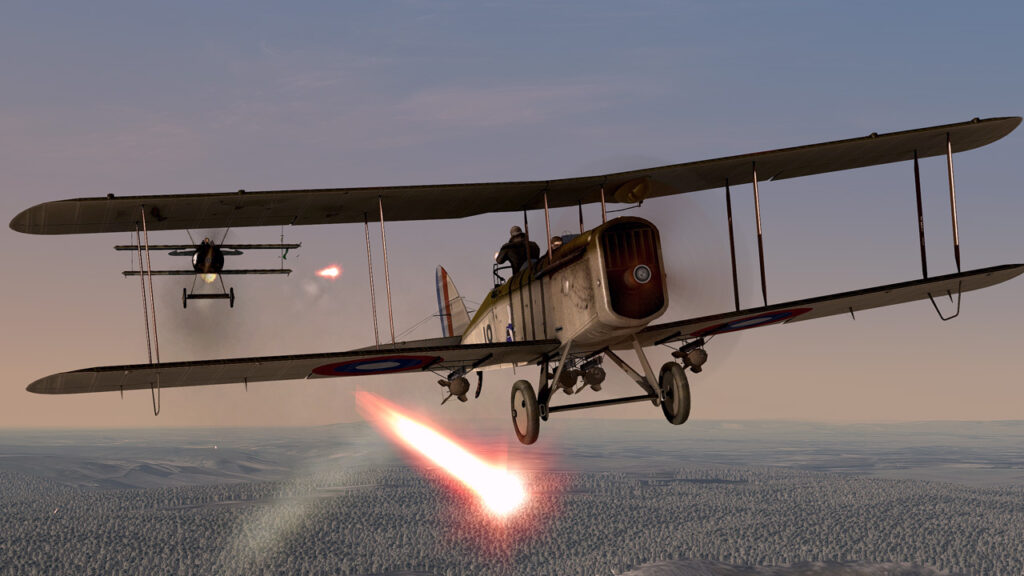
On this section of the front, northeast of Perrone, there was an excellent landmark. Earlier in the war a huge ammunition dump had blown up and exposed the underlying chalk leaving a large circular white area readily visible from the air for long distances. [Perhaps Lochnagar Crater?, 50.0155, 2.6973 - NW of Perrone] This guidepost had just come into view, and I was congratulating myself that we would be able to reach our side of the line when a burst of machine gun fire ripped through the gravity tank, allowing ten gallons of gas to pour over my head. It would have been relatively easy to elude the German by side-slipping steeply. However, this would mean losing height quickly and thus jeopardizing our chance of avoiding being taken prisoner. British machines were not equipped with parachutes in World War I.

We were being attacked from behind and below the tail and I began sharp "S" turns to allow Douglas to fire on the German fighter. I soon realized the Lewis gun was silent and I was unable to contact Douglas. I had to assume he had been hit by an early burst of fire.

DH4 Under Attack

The Germans were using three types of bullets in tandem: the tracer, the explosive, and the regular bullet. By following the flaming tracers, the course of each burst from the German machine gun could be followed. I felt a burning in my left ankle and knew I had been hit. The next burst hit the radiator and the water was lost. Bullets also went through the main gas tanks with the loss of all our fuel.

The danger of fire was one we all dreaded. I realized that, so far, we had been extremely fortunate in that all three gas tanks had been punctured by tracer bullets and this catastrophe had not occurred. The bullets began cutting the wing supports and the engine ceased with the propeller in a vertical position. Realizing that true valor lies between cowardice and rashness, I put the plane in a sharp side-slip. The firing ceased and I pulled out at about 3,000 feet, but the German was still on my tail. I was preparing to side-slip again when two British SE5 fighters appeared. The pilots waved and I felt quite confident I would hear no more from the enemy.

British SE5

My machine was without power, and as I was now only about 2.000 feet from the ground, I quickly chose a spot which appeared satisfactory for landing; however, on coming nearer, I could see my proposed landing area had been an orchard in which the tops of the trees had been blown away, leaving stumps reaching several feet above the ground. I planned to pancake the plane into soft earth, but when I pulled back on the stick it would not move. Douglas, having been wounded, had fallen and jammed the controls. The vertical propeller hit the earth and the airplane flipped over on its back. Douglas was thrown about twenty feet beyond the machine and my head went through the top wing. I scrambled out, and, as I recall, suffered very little pain from the wound in my ankle.

I crawled over to Douglas and found him alive but unconscious. I succeeded in placing a tourniquet above his knee to stop the bleeding. The lower part of his leg was dangling by only a few shreds of tissue. Except for the bullet holes and the broken propeller, the plane was not extensively damaged but the rear of the fuselage and the tail were covered in blood.

We had crashed about thirty rods from a sunken road, and I began hobbling in this direction seeking medical assistance. I was met by a Frenchman who indicated he was familiar with first aid. He agreed to look after Douglas while I continued to seek help. I was able to stop a British staff car and urged the officers to return to the nearest medical station to obtain help for Douglas. They hesitated as they informed me the German infantry was advancing rapidly. They finally agreed to return to the small village of Millencourt about one mile from the site of our crash.

I was able to arrange for medical help and ambulance to care for Douglas. I was then taken by sidecar to a nearby airdrome. When we arrived, the first aid station was vacant as the medical personnel were on the landing field. One of the pilots was in the air without his undercarriage and they were standing by to help when he landed. Fortunately, he did not crash and the first aid sergeant was free to dress my wound and give me a hypodermic, which I now realize was an opiate. I was again placed in a sidecar and we retraced our course through Millencourt and by the field where we had landed. By this time, the ambulance was leaving with Douglas on its way to the hospital.

Following this I remember very little until I awoke about 4:00 p.m. on a field which had been set up as a casualty station. At dusk I was placed in an ambulance with five other wounded soldiers and after travelling most of the night, over shell-pocked roads, arrived in Doullens and was admitted to the third Canadian hospital. Apparently I was given considerable sedation as my memory of what happened in the hospital is very vague.

Early the next day I was placed in a hospital train for Boulogne. This was a long and painful trip. We were able to travel only a short distance before being shunted to a siding to allow a long string of freight cars, loaded with guns and ammunition, to go by their way to the front. Our train arrived in Boulogne late at night and I was admitted to the eighth British Red Cross hospital.

On the third day, I was operated on by a British surgeon who removed pieces of boot, sock, and explosive bullet from the wound. two days later I was placed on a hospital boat for Dover. I was then taken by train to Waterloo station in London. About 4:00 a.m. I was picked up by ambulance and taken to the Prince of Wales Hospital, which had been Marylebone Station Hotel before the war. Inasmuch as there was a Zeppelin raid on London that night, I spent the remainder of the morning in the hall. I was confined to bed for about three weeks and then allowed out of bed on crutches.

I was fortunate in being under the care of Dr. Low [perhaps Dr Hugh Lett], one of the leading younger surgeons in London. I was interested to read in later years he became President of the Royal College of Surgeons. His skill in repairing my Achilles tendon was responsible for my complete functional recovery, although I was unable to resume flying for about seven months.

It was not until May 4th that I learned that Douglas had been hospitalized in Etaples and far from the English Channel, about twenty miles south of Boulogne. He had been transferred there by ambulance and was critically ill for several weeks. It had been necessary to amputate his leg shortly after admission. Soon after I received this information, Douglas was transferred from Etaples to Victoria Hospital near Buckingham Palace.

On my first visit I began to sympathize with him about the loss of his leg. He silenced me and said his wooden leg would soon be ready. When it was fitted he would go to his home in Scotland. As he was fond of tennis, he could be found on the courts surrounded by a bevy of beautiful girls. If he noticed them whispering to each other, he could be sure they were questioning why a husky young man was not in the military service. They would assume he lost his nerve. He would disprove this by drawing his revolver and firing a bullet through his leg without flinching. Needless to say, I did not mention this subject again.

Following the war, Lord Douglas entered the export and import business, and I became a physician. On visiting England in 1954, my wife and I had the pleasure of having lunch with Lord and Lady Douglas at the Ritz Hotel in London. It was quite nostalgic to reminisce about our "Last Bombing Raid of 1918" --- now fifty years ago.

Continue reading →
Posted in Uncategorized | 4 Replies

Tunesday – A Twofer For Armistice Day

The New American Digest Posted on November 11, 2025 by DTNovember 9, 2025

A sample of some obscure - and maybe not obscure - tunes from my strange and off-the-wall collection.

Today's selection(s):
Albert Farrington "Long Way To Tipperary" - 1915
Murray Johnson "Pack Up Your Troubles" - 1916

The guns fell silent at 11:00AM, November 11, 1918. Until 10:59AM, the battle raged on.
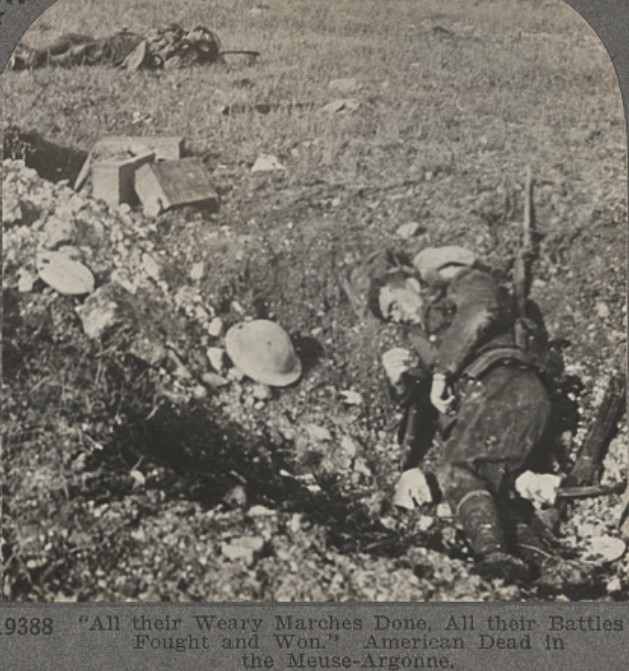
The Meuse–Argonne battle was the primary involvement of US troops in the war, lasting from Sept 1918 to 10:59, Nov 11.

All their weary marches done, all their battles fought and won.
Long Way To Tipperary

Written for English music halls in 1912, it was adopted as a British marching song during WWI.

It's a long way to Tipperary,
It's a long way to go.
It's a long way to Tipperary,
To the sweetest girl I know!
Goodbye, Piccadilly,
Farewell, Leicester Square!
It's a long long way to Tipperary,
But my heart's right there.

Pack Up Your Troubles

The song was written in 1915 by George Powell under the pseudonym George Asaf. It was written as a morale booster, encouraging recruitment. Its popularity was such that it became a favored marching song for British troops in WWI.

Pack up your troubles in your old kit bag
And smile, smile, smile.
While you've a lucifer to light your fag
Smile boys, that's the style
What's the use of worrying

It never was worth while
So, pack up your troubles in your old kit bag
And smile, smile, smile.

Both songs are strongly identified with WWI although the popularity of both went well beyond the war and into the 21st century.

Continue reading →
Posted in tunes, Uncategorized | 1 Reply

Rules

Gerard Van der Leun
12/26/45 - 1/27/23


Gerard's Last Post
(posthumous): Feb 4, 2023
"So Long. See You All a Little Further Down the Road"

When my body won’t hold me anymore
And it finally lets me free
Where will I go?
Will the trade winds take me south through Georgia grain?
Or tropical rain?
Or snow from the heavens?
Will I join with the ocean blue?
Or run into a savior true?
And shake hands laughing
And walk through the night, straight to the light
Holding the love I’ve known in my life
And no hard feelings

Avett Brothers - No Hard Feelings

The following was posted along with the announcement of Gerard's passing.
Leonard Cohen - Going Home

For a 2005 interview with Gerard


November 2025
S M T W T F S
 1
2345678
9101112131415
16171819202122
23242526272829
30  
« Oct   Dec »

Most Recent Comments

  1. G706 on GrandpaDecember 14, 2025

    No snow on the left coast, just rain and 45 degrees. The 1907 farmhouse is decorated for Christmas. Might sip…

  2. DT on GrandpaDecember 14, 2025

    I'm reminded of a Christmas card cartoon showing some guy in Arizona, leaning on his lawnmower enjoying a cold beer.…

  3. jean on GrandpaDecember 14, 2025

    Your house is beautiful, gs!

  4. ghostsniper on GrandpaDecember 14, 2025

    72, you lucky dawg. Over time that has proven to be my perfect number. More than a usual amount of…

  5. azlibertarian on GrandpaDecember 14, 2025

    I am at my best when in my role as a grandfather. I'd have been happy to have been left…


Blogroll
The New Neo
Jean's Blog

Hey, Mr. Tambourine Man,
play a song for me
I'm not sleepy
and there ain't no place I'm goin' to

Hey, Mr. Tambourine Man,
play a song for me
In the jingle jangle morning,
I'll come followin' you

Take me for a trip upon
your magic swirling ship
All my senses have been stripped
And my hands can't feel to grip
And my toes too numb to step
Wait only for my boot heels to be wanderin'

I'm ready to go anywhere,
I'm ready for to fade
Unto my own parade
Cast your dancing spell my way
I promise to go under it


Men who saw night coming down about them could somehow act as if they stood at the edge of dawn.


From Gerard's site. The picture always caught my eye.

Archives

  • December 2025
  • November 2025
  • October 2025
  • September 2025
  • August 2025
  • July 2025
  • June 2025
  • May 2025
  • April 2025
  • March 2025
  • February 2025
  • January 2025
  • December 2024

Contact: dt@newamericandigest.org

About "DT"

The New American Digest © 2024 - Weaver Xtreme Theme
↑