
The Zippo Lighter
submitted by G706
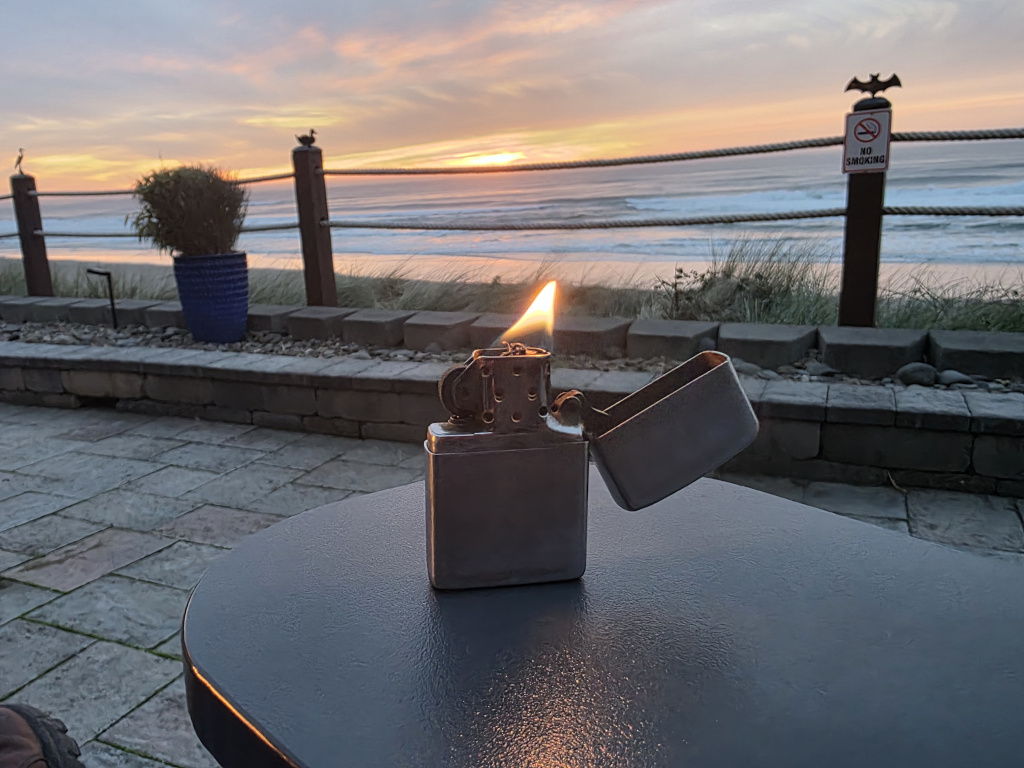
I have been carrying a Zippo lighter in my pocket for 4 years now, even though I don’t smoke. I carry it to honor a memory.
Uncle Rudy was not really my uncle, he was married to my dad’s first cousin, but when I was a child every adult who was familiar enough to not need to be addressed as Mister or Mrs. was referred to as Uncle or Aunt out of respect.
I remember him as a friendly, solid man, a sharp mechanic who worked at the local car dealer and played trombone in the band at the First Baptist Church. I know he served in the Pacific during World War 2 and had some health issues from that time. He died in a car accident when he was only 58.
Aunt Irene played the piano at the Baptist church. She never remarried and lived to be 96 dying in 2021. That summer her family had an estate sale at her farm. I was looking through the tables of knickknacks and stuff and saw the Zippo laying there among the bits of jewelry. I picked it up and paid the dollar price, took it home and replace the flint and filled it.
I like to think Uncle Rudy carried it during the war, but as far as I could know he never smoked. I looked up the serial number, it was made in 1966 so it was probably just for starting fires. Doesn’t matter to me, it’s a reminder of my neighbors and relatives of my father’s generation that served in Europe and the Pacific. The ones who came back and fought the demons of war silently or carried the wounds of battle and those that never came back.
G706, keep that Zippo in good shape. You will need it if an EMP ever hits.
BICS will work fine after an EMP and are my preference.
I have plenty of Zippo’s but they have a problem – they need refiled, and they leak.
BICS are good for hundreds of lights and, if kept in your pocket, will light in cold weather.
Every time I leave the compound I have a full size BIC in my pants pocket and the safety guard has been removed.
The smaller BICS are problematic with normal size adult hands.
Stay away from the generics as they will let you down when you most need it.
Few years ago I bought a box of 50 BICS on amazon.
I agree, BICs are cheap and reliable. The Zippo is always empty when I want it. I think the fluid evaporates, it doesn’t leak enough to be noticed. But then I carry for the memories and maybe the cool factor a bit.
In that vein, I was out front earlier today and a B-25, Maid in the Shade, from a nearby Commemorative Air Force* unit flew overhead. Last year for Veteran’s Day, it was their B-17, Sentimental Journey.
And I wondered: What kind of life would I have lived without the having had the benefits of the sacrifices of those who flew them originally? I draw back to Gerard’s namesake.
* The CAF had to change their name from the original “Confederate Air Force”, because the South had an Air Force in our Civil War. Or something. Conflating the Confederate Air Force with anything to do with the Civil War, even remotely, was, to my memory, one of the first “flexes” of the Lefty Woke over our language. None of that has made us better.
There’s something about them military planes that gets me up out of the chair PRONTO!
No mufflers!
Just raw assed power, like they should be.
We live about 20miles west of Camp Atterbury and now and then they let some stuff fly and it’s spectacular. Few days ago it was 3 C130’s side by side. That makes the earth shake and my blood pressure spikes!
[Fair warning: Military acronyms are inbound.]
C-130s might fly in formation, usually nose-to-tail, using day VFR, but inside the cockpits, they might be tempted to back up their eyeball senses of whether they were in position with what their radars were telling them (One cheat is worth a thousand crosschecks.). However, while a radar will tell you where the other guy is, it also tells the entire world that you’re here too. Radars are like flashlights: They illuminate what is on both ends of their beams.
Back in my day, some C-130s had a system on board to allow them to fly in formation without seeing each other at all. The entire formation…5-, 10-, or 20 planes….could fly a route to get themselves over a drop zone without ever seeing the other planes or the ground. The units at Pope AFB were equipped with AWADS radars which allowed them to “map” the ground while airborne and determine where, exactly, the drop zone was.
At the time, the plan was to spread these AWADS planes and crews out among the larger numbers of non-AWADS planes and have them lead the formation to the DZ.
But how do you get them there? That required another system…SKE. SKE was modified off of the equipment that allowed WWII naval convoys to both stay together and maneuver while they made their way across the Atlantic.
In our C-130 formations, there’d be maybe 2 minute spacing between planes. When the lead came to a turn point, you couldn’t just have everybody turn at the same time….imagine a large group of elephants walking nose-to-tail along a trail. They each need to turn at the turn point and not at the turn time. With SKE, the lead plane would send out a signal…a heads up…that meant “I’m turning to the next heading in 1 minute.” Once at turn point, he’d send out another signal meaning “I’m turning.” At that point, the following planes hacked a watch, and based on whether they were closer-than-in-ideal position, in-position, or further-out-than-ideal, they’d adjust their 2 minutes separation in order to finish the turn in position and on time. Wash, Rinse, Repeat throughout the route until they got to the DZ and then there’d be another signal from lead that he’s dropping his load.
The idea here was that the entire formation should each drop their loads on the same drop zone and not drop the people or equipment all across the countryside.
In theory it worked and in practice, it mostly worked. Flying the route was an exercise in staying in position and being on time. If one plane flies a turn at 25° of bank and the following plane flies it at 30°, well, when they finish the turn those differences are going to show up as being out of position. The same applies with airspeed variation. Every correction that one plane applies creates variation that the next guy will have to solve for. It was like trying to keep a giant Slinky stretched to a uniform length as you dragged it around the house.
C-130s: Churning the air into submission since 1954.
VFR=Visual Flight Rules
AFB=Air Force Base
AWADS=Adverse Weather Aerial Delivery System
SKE=Station Keeping Equipment
Where and how long did it take to learn all that??!
I learned to fly the C-130 at the Air Force’s C-130 “schoolhouse”….Little Rock AFB, located at (wait for it) Jacksonville, AR. [In fairness, Jacksonville is just 15 miles NE of Little Rock.] I came to the C-130 after having spent 3 years as a T-38 FAIP (another acronym). I was at the schoolhouse twice….once to learn how to fly from the right seat as a copilot, and then about a year later to fly from the left seat as an AC. Rank has almost no bearing while on a crewed AF plane. The navigator might be a Lt.Col., the copilot a Major, and the guy in the left seat a mere Captain, but while on the plane, the AC…the Aircraft Commander…is making the decisions. However, on the ground, ranks resume.
Learning in the Air Force was a career-long endeavor. You’d go to UPT, then your training on your operational plane. Those are 2 separate schools. At some point, you’d become an instructor on your plane….that’s another school. Many end up going to the AF’s Weapons School to become their squadron’s expert on the wartime employment of their mission. [I have a son-in-law….a really, really sharp guy…who wears “The Patch“. He hated the Weapons School….kicked his ass.] An officer is expected very early on to get an academic Masters degree, and then there is the PME….a series of in-house or correspondence courses on military topics. You could spend an entire 20-year career either at a school or about to go to one.
I should also leave you with this caveat: My experience in the AF is now 40+ years old. There has been a lot about the AF that has changed since I was in. The names and locations may change and the sequence of what-happens-when may be different, but the focus on career-long education remains.
FAIP=First Assignment Instructor Pilot…someone who’s first assignment out of UPT was to turn around as an instructor in UPT.
UPT=Undergraduate Pilot Training. UPT is where a student would be trained to become a pilot. After graduation from UPT, the new pilot would head off to another schoolhouse (as I did when I went to LRAFB) to learn to fly the plane s/he would fly in the operational AF….a F-16, a B-1, a C-130, etc.
PME=Professional Military Education
Commendable that you still remember all them acronyms. Just this morning in the shower I was trying to remember one from my time in, and failed. Don’t laugh, you’ll be 70 soon enough. lol
An additional note….
Maybe you’ve found my description of my former life on the C-130 as interesting. And if so, I appreciate it.
But there are tons of other careers which are also interesting. A simple farmer has to know his land and the crops that will do well there. He has to watch the weather. He has to understand the futures markets for his crop. He has to know how and when to rent, buy or sell his equipment and how to maintain it all. He will have a ton of details about his professional life that were he to sit down and write about it, others might find interesting.
Do that again with nurses and insurance agents and bankers and pretty soon everyone has an interesting story.
Cool stuff AZ, I could read that stuff all day. Sounds more complicated than one might think. The only thing I know about a C130 is the view out the side door.
A bit of myself:
Some people are at the point of the spear, some others build the spear. I was once assigned TDY at Lockheed-Marietta. That’s where the C130 was built. Also the C5 which was one impressive airplane. Amazing factory. I never followed through but I’d like to have flown one of those big ones. B52, C5, B1 …
Late stage Vietnam was not an encouragement to join the military although technically I was drafted but had the orders rescinded. Vietnam may or may not have been a mistake but I never thought the returning soldiers were “baby killers”; that type of attitude turned me off the “hippies” early on (way too young to vote but I favored Goldwater in 64. McGovern cemented the anti-Democrat in me)
I worked for a short while for Martin-Marietta in Torrance CA on a 7500 ton stretcher. 80′ long, 2000lb lengths of T shaped aluminum said to be wing struts. Now THAT was an amazing factory. Took more than 20 mins to walk from my ride in the parking lot to my work station. 80′ tall ceilings with overhead cranes riding on half mile long tracks. That was the most money I ever made as an employee – $8.50/hr and a mandatory 10hrs per week overtime at time and a half. DAWG!!!
On planes – Galveston has/had a working B-17. Flew on it once as a birthday present. All one has to do is look around and imagine the waves of daily crews of the barely twenty-somethings. Incredible
On Zippos – 60 years ago I was a waiter in my Uncle’s restaurant. All the waiters carried Zippos and we had a running contest in the kitchen to see who could light the most cigarettes for our guests each evening – ‘swooping in’ as a gallant move just in time for the flick. We developed a ‘show-off’ technique (or tried to). If you hold it just right you can ‘snap your fingers’ around it and open and ignite it all in one fell swoop – an extra impressive move. One night my Uncle was entertaining associates and I was waiting his table. I swooped in with my patented ‘flick move’ and flipped the entire Zippo right into his cup of coffee! Bad move.
Just yesterday I got a zippo out and did the ‘flick move’ and it went flying across my desk. Been many decades since I tried that and the ol’ fingers don’t work like they used to.