Happy Turkey Day
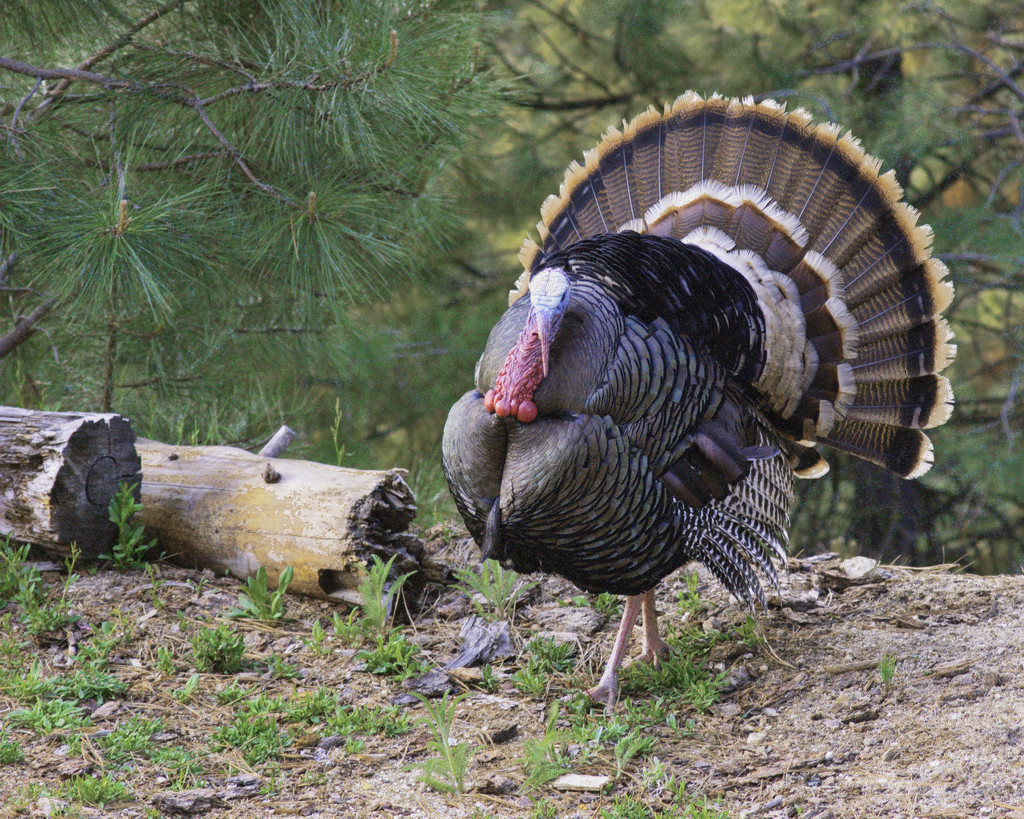
In spite of everything, there is much to be thankful for.
A Happy Thanksgiving to all.

In spite of everything, there is much to be thankful for.
A Happy Thanksgiving to all.

The leaves are gone, so are the soft, warm summer days. Frost has made the remaining hangers-on soft and mushy; the last fresh food of the season for some of the wild critters. The new shoots of spring are far in the future - the worst of winter is yet to come.
Continue reading →originally posted by Jean March 20, 2010
dreams that will never
be haunt me in the daylight
break my heart at night
A sample of some obscure - and maybe not obscure - tunes from my strange and off-the-wall collection.
Today's selection: Ragdolls - "Dusty" - 1964
The Ragdolls were formed as a "female Four Seasons" in New York by the producer of the Four Seasons. Dusty was their second release but their first (and only) chart breaker (Billboard #55). At a time when 4-track recorders were standard, this song was recorded on the second 8-track recorder in existence at the time; the other being at Motown. The group was a corporate entity; performers varied depending on circumstances.
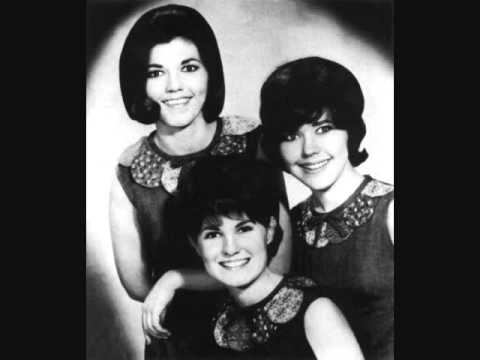
I admit to having a taste for the "girl groups" of the early 60s; this was among my first 45s bought as soon as old enough to do so.
Continue reading →A guest editorial from today's Idaho Statesman (Boise).
"A rabbi’s warning to America about Idaho’s Christian nationalism"
Opinion By Rabbi Daniel Fink
I'd rather live in a Christian-based country than jewish or muslim or woke ... even if Christians do not consider me Christian.
Y'all knew I was right-wing when I started this blog.
The Idaho Statesman is a left-wing paper which supports Idaho becoming yet another woke state. The Boise city government is deep blue, the most populous metro region in the state by far, the state capital, and in full support of sanctuary status, "affordable housing", light rail, and other such money sinks.
"You're free to have your opinion as long as it agrees with ours"
On to Fink's editorial:
I’ve learned it is rarely a good thing when national media features Idaho. It’s often about the state’s horrifying abundance of right-wing extremism. No different was a recent New York Times piece spotlighting Doug Wilson, a self-described theocrat and pastor based in Moscow, Idaho, whose disciples now include powerful MAGA acolytes in the federal government.
I urge all Americans to stand up for true freedom and reject Christian nationalism.
For many years, I hoped that Idaho would moderate to grow more like the rest of America. Instead, America is becoming more like Idaho. Religious reactionaries like Wilson have emerged to lead a far-reaching movement to cement power in the hands of a theocratic minority. Their goal is clear: Replace democratic governance with fundamentalist rule.
Idaho’s reactionary right-wingers are hell-bent on creating a Christian nationalist dystopia, and residents are suffering. Far-right extremists and militia members — often heavily armed with assault weapons and hiding their faces with masks — regularly occupy public spaces. They’ve normalized intimidation and exclusion in the name of faith. Their fear tactics are working, especially in our statehouse, where the lopsided Republican Legislature has unleashed a torrent of laws to undermine Idahoans’ fundamental freedoms.
Despite its longtime libertarian reputation, Idaho now has one of the nation’s most extreme abortion bans, which has driven OB-GYNs and young families out of the state in record numbers. The ban has put the health and lives of women who remain in Idaho at profound risk.
The legislature has also continuously targeted the LGBTQ+ community, banning displays of Pride flags, curtailing medical care for transgender individuals, and even calling to reverse same-sex marriage rights. Christian nationalist lawmakers have slashed Medicaid and pushed an out-of-state-billionaire-backed school voucher bill that undermines public education and funnels taxpayer dollars to religious institutions — in clear violation of Idaho’s state constitution.
Far-right out-of-state groups fund this nightmare, bankrolling reactionary candidates against moderate Republicans who once joined with Democrats to support public schools and defend personal liberties.
With the Trump administration in the White House, Idaho’s extremist takeover should serve as a cautionary tale for all Americans. Christian nationalists have been waiting for an ally like President Trump for many decades. His actions have emboldened lawmakers across the country to follow the Idaho agenda, from book bans to abortion rollbacks and anti-trans bills.
It is no coincidence that Trump appointed Pete Hegseth — a prominent disciple of Pastor Wilson’s church network — as Secretary of Defense. Hegseth re-posted a CNN video in which Wilson and other Christ Church pastors argued that women should not be allowed to vote. The president’s so-called “Religious Liberty Commission” is riddled with televangelists and misogynistic extremists. They share a devotion to Christian nationalism that demonizes LGBTQ+ individuals, immigrants, women, and people of color.
I’ve seen what this agenda has done to Idaho. It should serve as a warning for all Americans. If you care about democracy and human decency, now is the time to raise your voice in pulpits, halls of power, and protests on our streets. Our response will determine whether we remain a nation that moves slowly toward greater empathy and tolerance or devolve into one that anoints a chosen few above all others.
Here in Idaho, faith leaders and community coalitions are mobilizing for civil disobedience, lawmaker visits, and peaceful protest when legislators return to session on Jan. 5. That includes organizing bail funds and securing pro-bono legal support. Our message of “live and let live” resonates with those wary of government-mandated religious law, no matter their political affiliation. If we can do this, you can, too — wherever you work and live.
Idaho should serve as a call to action rather than a harbinger of a national dystopia. The freedoms of millions of our neighbors are at stake.
I urge people across all walks of life to stand up for true freedom and resist the Christian nationalist agenda. Our voices matter. I pray we find the strength and courage to use them well.
Daniel Fink is Rabbi Emeritus of Congregation Ahavath Beth Israel in Boise, Idaho.
I don't really care one way or the other about "Jews" in general, anymore than I care about Catholics or Baptists; I'm usually not even aware of who may or may not be Jewish - and it rarely matters. Israel has the right to exist ... as long as they are able to defend themselves. But Israel is not a US state and doesn't need our support (remember the USS Liberty?)
However, this is a Christian-based country which does not dictate a State religion (as did many European countries back when) and has the tolerance to allow people of all faiths to worship more or less as they choose - or not. I will take this guy's opinions as independent of his faith ... not that he appears to be willing to accept our opinions of faith. "Tolerance for the sake of tolerance is not a virtue"
This guy - rabbi or not - is so far off my beliefs that I could consider him an "enemy" if it really came down to it.
"Far-right extremists and militia members — often heavily armed with assault weapons and hiding their faces with masks — regularly occupy public spaces."
Seems to me that's the far-left Antifa people hiding their faces. See Portland as an example.
"Idaho now has one of the nation’s most extreme abortion bans, which has driven OB-GYNs and young families out of the state in record numbers."
Abortion is murder. Reality and circumstances suggest exceptions should be accepted but ... murder it is. If you feel differently and that strongly, there are other places to live.
"The legislature has also continuously targeted the LGBTQ+ community, banning displays of Pride flags, curtailing medical care for transgender individuals, and even calling to reverse same-sex marriage rights."
Rights? Seems they have more "rights" than most people. The ban on TranzyFlags applies to government buildings - which ban all but official government flags (US and State flags). The curtailment is against tranzy surgery for minors.
I could pick apart almost every paragraph this ding-dong presents. I'm happy to live in Idaho where the "woke" are usually discouraged ... but the Boise city government wants Idaho to be another Washington, Oregon, California, Colorado. There are plenty of places where this guy would be welcome with his views. I'd like to invite him to move to one of those places.
Continue reading →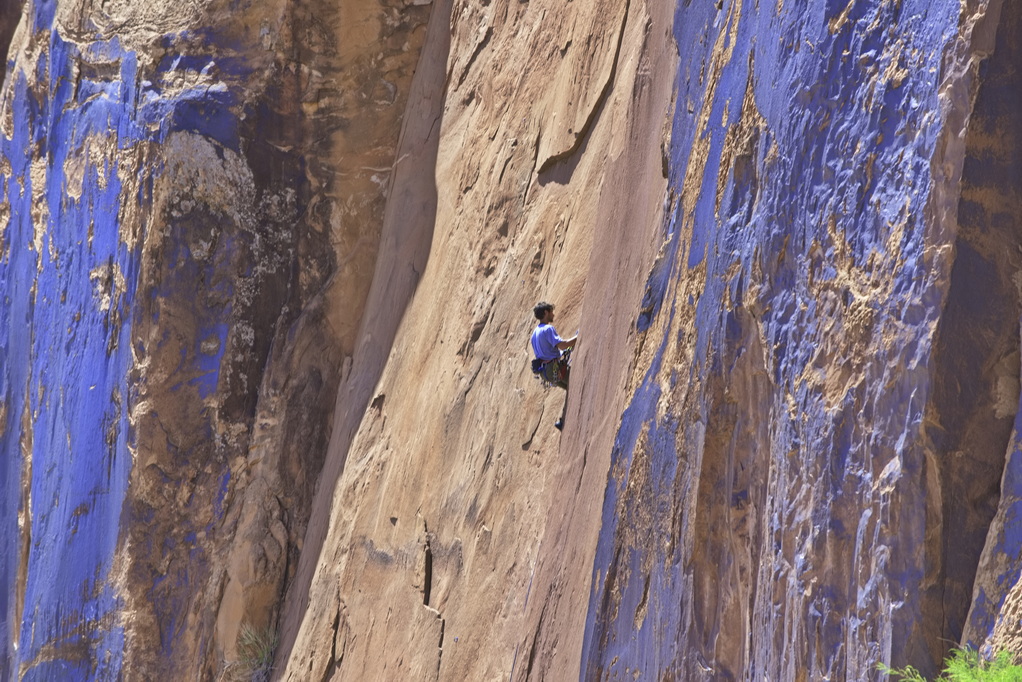
I once told myself I'd take up rock climbing if:
1) there was "something" up there worth seeing
2) I could chin myself with my off-arm (left in my case) 20 times and hold the position for at least a minute
To my knowledge, neither has occurred.
Continue reading →via a comment from Joe
by Stephen Soukup November 22, 2025
The other night, I was blessed to have dinner with old friends, friends who were once the best I had in the world but whom I hadn’t seen in ages. The good news is that, even after all these years, we were able to pick up our friendship right where we had left off, as if no time had passed. There were no awkward silences, no conflicts over newly differing opinions, and no embarrassment over life changes, victories, failures, and all the rest. It was good.
The better news is that during dinner, something happened that both reminded me of why we were such good friends in the first place and also reminded me of important and eternal truths.
I arrived at dinner right on time, walking over from my hotel on a cool and rainy evening, passing a homeless man, sprawled out on a bench, wrapped in a ragged, old blanket, right in front of the restaurant. He said nothing to me. Inside, one of my oldest friends had already been seated and was waiting for the rest of us. Not long afterward, the rest of our party joined us.
Maybe twenty minutes later—as we were finishing our first drinks and were about to order food—our waitress brought a to-go meal and coffee out to my friend, the first to arrive. He excused himself, took the meal and coffee outside, and returned a few moments later. You see, he, too, had passed the homeless man, but, unlike me, had been asked for his spare change. He apologized for only having fifteen cents to give the man, but promised to make up for it. The meal and the coffee were his way of making up for it. When we asked why he felt obliged to do so, he told us that he didn’t feel obliged at all. He just figured that, as the four of us (me, a conservative, and the rest libertarians) were going to be sitting around, complaining about the government and kvetching about the size and scope of the state, it was only right that he do something to help someone, outside of the purview of the state.
As I say, this reminded me of why we had been such good friends in the first place. He is kind and generous and decent, but subtle and composed about it all. He’s a good man, but never asks to be recognized as such.
And there are lessons in his behavior.
First, kindness, generosity, and decency are virtues. Of the four cardinal virtues—prudence, justice, fortitude, and temperance—they all fall under the heading of “justice.” A just man is kind and generous, not for the sake of acknowledgement or admiration, but because he knows that he has been given much and, in turn, that much is expected of him.
Sadly, as I’ve written repeatedly over the decades, echoing such intellectual giants as Alasdair MacIntyre and C.S. Lewis, truly virtuous men and women are in short supply these days. As MacIntyre noted, this is due, in part, to the slow but nearly complete switch in our civilization from an ethics based on virtue to one based on “values” and the loss of moral sense and community resulting from that switch. It is also due, in part, to society’s failure to insist on the teaching of virtues and the inculcation of successive generations with the thoughts and behaviors that enabled our civilization’s rise and facilitated its survival. As every virtue ethicist since Aristotle has understood, virtue must be taught, and it must be reinforced, over and over again. As C.S. Lewis put it in his “The Abolition of Man”: “The little human animal will not at first have the right responses. It must be trained to feel pleasure, liking, disgust, and hatred at those things which really are pleasant, likable, disgusting, and hateful.”
Unlike much of our generation and even more of successive generations, my friend was properly “trained.” He was taught and compelled to practice the virtues that matter and always have mattered in our civilization. How do I know this? Well, in addition to seeing his behavior, I know his brother, who just happened to be one of our other dining companions the other night. And I know that he, too, is a kind and generous and decent person. Moreover, I know their parents, who are among the kindest, most generous, and most decent people I have ever met. They’re all good people. I am privileged to know them.
A second lesson here is one that is particularly relevant today, as Americans fight over such public welfare initiatives as SNAP, the Supplemental Nutrition Assistance Program. As you may recall, during the recently ended longest-ever federal government shutdown, SNAP benefits were delayed. Many people on SNAP grew angry, hostile, and even violent at the prospect of having their benefits halted, if only temporarily. Democrats accused Republicans of trying to starve their constituents and of conspiring to commit genocide against the poor (and no, I’m not exaggerating). Meanwhile, President Trump’s supporters were equally agitated, with some complaining about SNAP recipients’ “sense of entitlement,” as well as the rampant fraud and abuse in the system that, in the end, takes advantage of those who work for the benefit of those who don’t. Some scenes were indeed quite ugly.
Now, I know that American conservatives revere Alexis de Tocqueville most for his brilliant observations about early America and his equally brilliant observations about Revolutionary France. For my money, though, his most brilliant yet almost entirely ignored observation was one that he made about Great Britain in his largely overlooked Memoir on Pauperism, which he delivered to the Royal Academic Society of Cherbourg in 1835. The memoir is about “public charity,” based on the ruinous effects of Britain’s Poor Laws, and in it, Tocqueville notes the inevitable and deleterious effects of state-sponsored welfare:
The law strips the man of wealth of a part of his surplus without consulting him, and he sees the poor man only as a greedy stranger invited by the legislator to share his wealth. The poor man, on the other hand, feels no gratitude for a benefit that no one can refuse him and that could not satisfy him in any case . . . . Far from uniting these two rival nations, who have existed since the beginning of the world and who are called the rich and the poor, into a single people, it breaks the only link that could be established between them. It ranges each one under a banner, tallies them, and, bringing them face to face, prepares them for combat.
In his first apostolic exhortation, Dilexi Te, Pope Leo XIV rightly demanded that Catholics maintain their personal charitableness but also, more or less, endorsed the view that the state must be the primary material provider for the poor. Pope Leo denounced “ideologies that defend the absolute autonomy of the marketplace and financial speculation” and that, consequently, “reject the right of states, charged with vigilance for the common good, to exercise any form of control.”
One might say the Pope is tilting at windmills here, since such ideologies are largely nonexistent and are practiced nowhere on earth. Even Tocqueville, nearly two centuries ago, acknowledged that the state must be the backstop for those circumstances when private charity inevitably fails. One might also say that the Holy Father is ignoring human nature and, by extension, making matters worse. As the rise of neo-socialism and the recent anger over SNAP demonstrate, and as Tocqueville warned 190 years ago, envy is the inevitable result of the overweening welfare state, as are resentment and frustration. One side in the public welfare equation resents what it is “forced” to provide, while the other assertively demands what it is “owed.”
By contrast, when my friend returned from delivering the meal to the homeless man, he was smiling from ear to ear—in large part because of the deep gratitude the food’s recipient had expressed to him. Public charity is inarguably a necessity, and it is not an evil in itself. Nevertheless, excessive reliance upon it tends, as Tocqueville noted, to destroy the virtues of both the “givers” and the “receivers.” Private charity does the opposite. It reinforces the virtues of generosity and gratitude.
A third, related lesson from the events of the other evening is that the practice of virtues is contagious. As it turns out, my friend only bought dinner for the homeless man. The coffee was bought and paid for out of her own pocket by our waitress, Cynthia, who was moved by my friend’s generosity and also wanted to help. Cynthia, I would wager to say, gave more out of her poverty than out of her surplus. Yet she did it and did it happily.
It’s amazing—and easy to forget—what people can do when encouraged to be virtuous. Life may, as Hobbes insisted, be nasty, poor, solitary, brutish, and short. But the people who experience it are not, at least not when they are allowed to be otherwise.
Continue reading →Someone recently reprinted this Far Side cartoon and it brought back memories ... and you have the dubious privilege of having me tell of them.
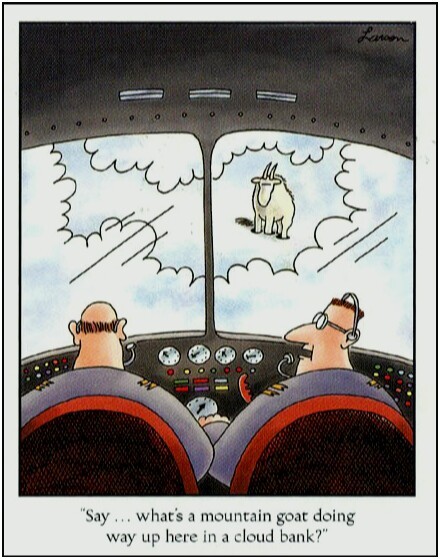
Sometime back in the early 90s, I had a job supervising aerial oil surveys over the upper headwaters of the Amazon and foothills of the east slope of the Andes in eastern Peru. "Supervising" being a relative term; it was me and the pilot.
We left from a small private airport east of Denver (which no longer exists) and flew by hops down to Pucallpa, Peru (8°23′S 74°31′W; 500ft elevation) where we based operations. Pucallpa is the regional capital and sits on the banks of the Ucayali River, the primary headwater of the Amazon River.
We buzzed around over the jungles at the eastern foothills of the Andes in a plane like this one: a Piper Aztec (after flying it down from Denver). There were the two front seats and 4 passenger seats - in our case, the passenger seats were removed and the cargo space filled with survey and recording equipment. A video recorder was pointed straight down through a hole in the fuselage and the magnetic field sensors were located at the end of a 10-foot stinger off the rear tail.

For some reason, this seemed to attract the attention of the DEA ...
It also attracted the attention of the Sendero Luminoso. The latter shot at us, the former didn't (I think) ... but they were very, very interested.
We were based at the military side of the airport which led to some interesting situations but all was good.
Don't drink the water, use ice cubes, or eat fresh vegetables in a third-world on a first-world stomach.
So to the point of this story:
We were buzzing around on gridded flight patterns that were very similar to plowing a field: 100 km one way, turn around, shift over a few km, repeat in the other direction. Repeat as necessary. 6 days a week for 3 months.
I was the equipment operator; this required me to be prone on top of a platform between the equipment. On one of our flights, I heard the pilot telling me to hang on.
It's wet in the equatorial jungle. Makes Seattle look dry. Clouds form at the uplift of the mountains. GPS didn't really exist yet, the region was not fully surveyed.
The ceiling of this plane is just shy of 19,000 ft. The Andes rise to over 20,000 feet. We came out of the clouds and saw dirt. And trees. One should not see dirt and trees in front of you when staring out the front window of an airplane at 15,000 feet.
All I could do was grip the equipment rails and try to hold still so as to not upset the balance of the plane. I didn't know this plane could perform this maneuver. We pulled up and over ... and headed back to base; that was enough flying for the day.
When we landed, the pilot told me he had undergone a transformation: "I took off as a man; I landed as a chicken".
One does not expect a camera pointed down from an airplane to record images of the undersides of leaves ...
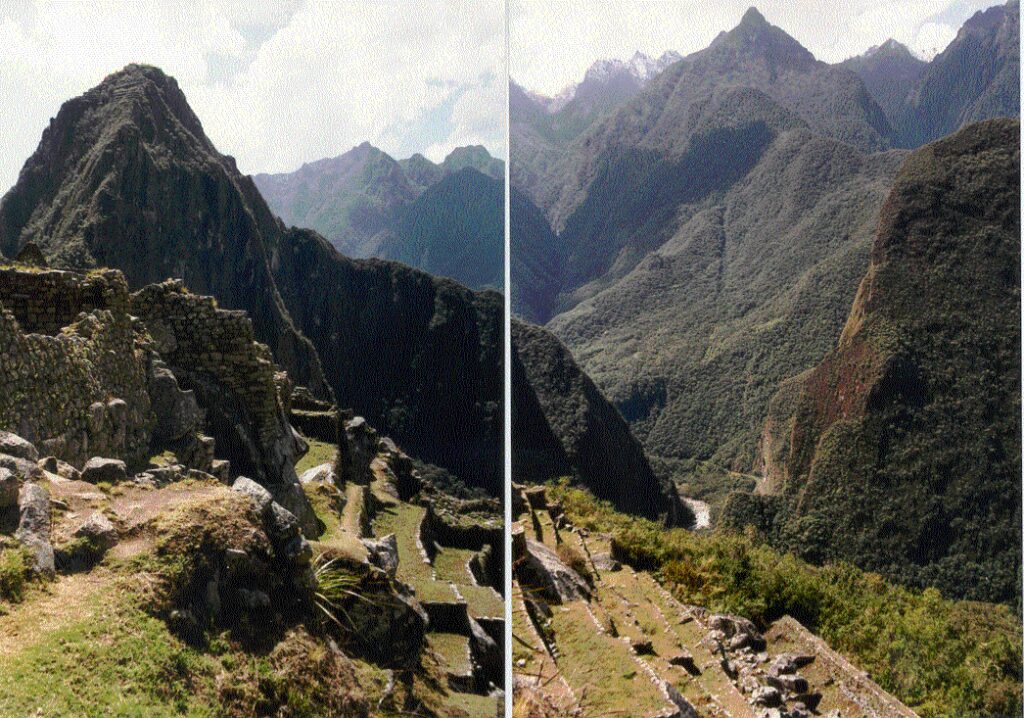
When the surveys were completed, we flew back to Lima, and the pilot took the plane back home to Denver; I took the opportunity to visit Machu Picchu.
Another tale, same trip ...
While in Lima, I arranged to join an English-speaking tour group to Cusco. I was accepted (Yankee dollars) but I was the last-minute addition. Caught the red-eye flight out of Lima (sea level) to Cusco (11,000 ft). Only a bit over 1 hour flight
Cusco is in a valley ... the mountains surrounding Cusco rise to over 20,000 feet.
So anyway, being the last-minute tail-end Charlie of the group, I had to stay at a different hotel than the one the tour group had booked - Cusco is a tourist town after all, it was August, and the hotels were booked. The group I was with were Europeans and Australians just coming in from the Galapagos; I was the only American. They didn't hate us then.
It was an early AM flight; I got dropped off first at a place the tour company arranged for me and the rest of the group went to their hotel.
Coffee. It's time for coffee.
I was the only person in this dining room. Not even staff.

All of a sudden, some little guy came out of the back, presented me with a cup of camomile tea - so I thought, and left before I could speak (No habla Espanol).
"Wait a minute! I want some coffee!"
But the tea was hot and it was cold out. Took a sip.
"Wow! That's better than coffee!"
Turned out that the camomile tea was actually coca tea. Coca is legal and common there (I could buy a box of coca leaves the size of Celestial Seasonings tea boxes for 50¢ American at the airport. I had the thought that may not be a good idea).
Everything we expect coffee to be. Wide awake and full of energy. Must be bad for you ...
Turns out coca tea is a good for reducing the effects of altitude sickness. Having been adapted to Colorado altitudes (Leadville is at the same altitude), I wasn't affected but the rest of the group were sea-level people. Serving coca tea to tourists is a routine.
Spent some time wandering around Cusco ...

Having joined the group got me accommodations and tickets but I was essentially on my own; the group's tour bus was full. Last minute Charlie effect. I hired an English-speaking guide for an auto tour of the area. Most of the drive was between 11,000 and 13,000 feet ... in the valleys.
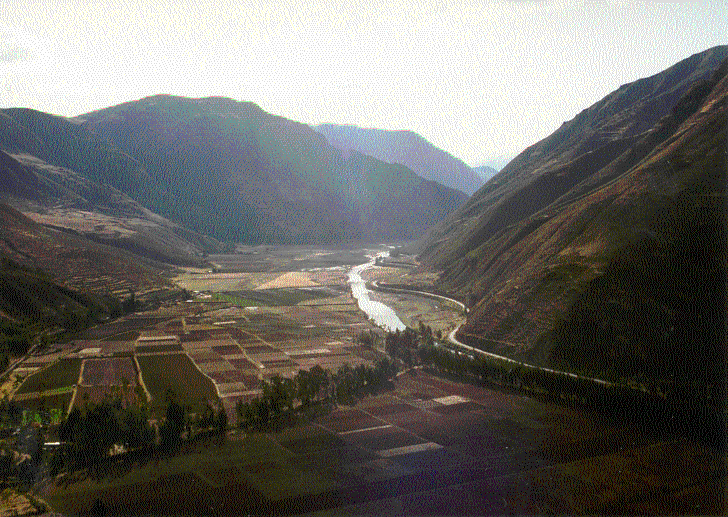
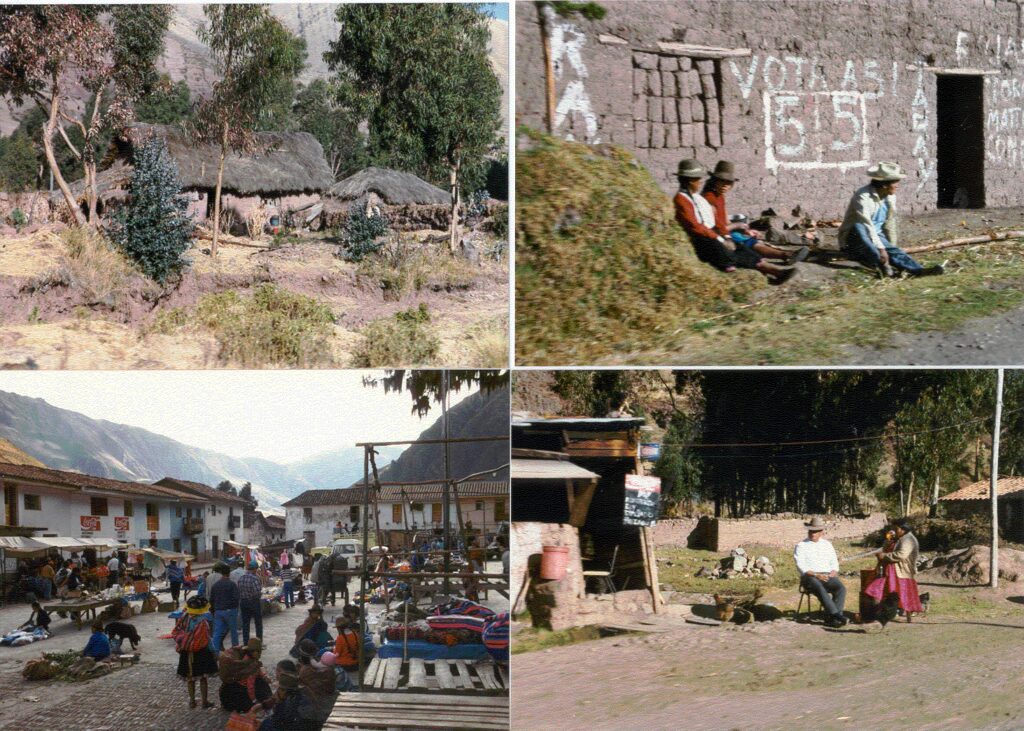
Came back then caught the train to Machu Picchu the next day. Other than the flight over (when most of the group were taking naps on the red-eye), this was the only time I was with the tour group.
Caught the flight from Cusco to Lima the next day; stayed at the Lima airport to catch an American Airlines flight to Miami, then a domestic flight back to Denver.
Worst part of the trip? Coming through the Miami airport on the way home.
Continue reading →Today marks the 62nd anniversary of the end of America as it might have been and the beginning of the America that is.
On this date in 1963, Lyndon Baines Johnson was sworn in as the new president of this not-as-bad-as-other-places country of ours.
Do you remember where you were on this date?
DT remembers ...