
Fetterman Massacre
December 21, 1866: Second only to Custer’s misadventure 10 years later
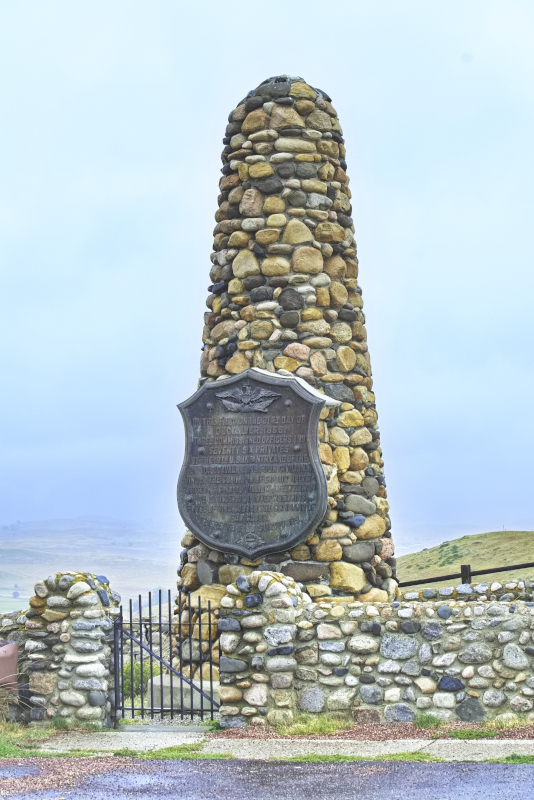
It was a cold and lonely day when I was there
Background
The Bozeman Trail was an offshoot of the Oregon Trail, leading from just west of Fort Laramie, crossing the North Platte River, heading north through central Wyoming, east of the Bighorn Mountains, to the gold diggings at Virginia City, Montana. Four military forts were established along the route, the first three in Wyoming, the fourth in Montana: Forts Reno, Phil Kearney, and CF Smith on the Wyoming/Montana border, and Fort Ellis near Bozeman Pass just east of today’s city of Bozeman. I-25 from Casper north roughly follows the old trail. The trail was rough; travel took about 2 months from Fort Laramie to Virginia City, MT. Passage with a wagon train cost about $5 but the route was primarily a freight road.
The trail saw heavy use in the mid-1860s and travelled through Indian lands.
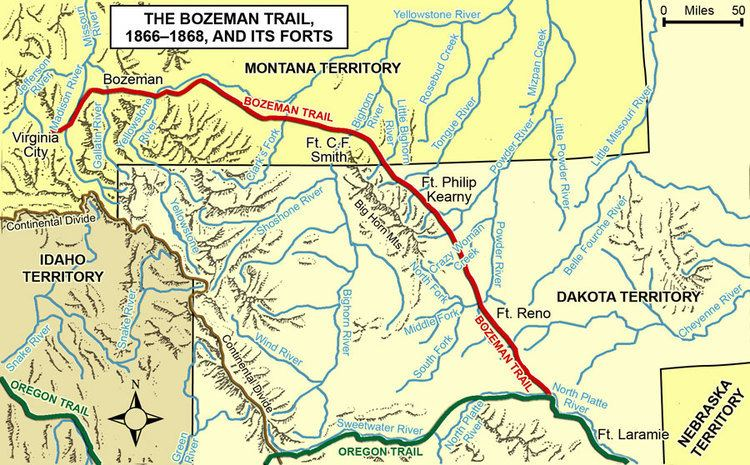
The Fort Laramie Treaty of 1851 gave the US the right to establish roads and forts in the territory; it also designated the region as Crow territory. Even though the Sioux, Cheyenne, and Arapahoe accepted the treaty, they began to ignore it and the Crow, whose land this was by treaty, were pushed west and the Sioux, Cheyenne, and Arapahoe took control of these hunting grounds. Although the land by treaty (also agreed to by the Sioux) was Crow land, the Sioux claimed the land east of the Powder River but attacked the route and forts which were west of the river. The Crow tended to side with the whites in conflicts with other tribes; it was their land they fought for and the whites tended to defend the treaty.
The Sioux were recent newcomers to the land, having been pushed out of the northern Great Lakes country, pushed west into Minnesota, then into the Dakotas in the 1850s. They obtained horses in the 1700s and by the mid-1800s, had become the most powerful tribe of the Plains. The name “Sioux” is derived (by the French) from the Ojibwa from a term meaning “enemy” or “little snakes”. They eventually moved to the Black Hills in the late 1700s, pushing the resident Cheyenne to the Powder River country of Wyoming by 1860.
The most dangerous section of the trail was the roughly 250 miles between Fort Laramie and the crossing of the BigHorn River where the trail started to head west.
In the summer of 1866, Colonel Carrington established the three Wyoming forts with Fort Phil Kearney as his headquarters. All three were nominally on Crow territory but the Sioux and allies fought the Crow to take over the fine hunting grounds of the region. The whites ended up in the middle of an inter-Indian war. In total, there were about 700 soldiers and 300 civilians spread among the three with Fort Kearney having about 400 soldiers and almost all civilians stationed there. About 3500 whites used the trail in the few years it was open
The forts were under frequent Indian attack during construction with groups of 50 or more Indians in each attack. By November, a company of cavalry arrived along with two Civil War veteran captains, Bingham and Fetterman.
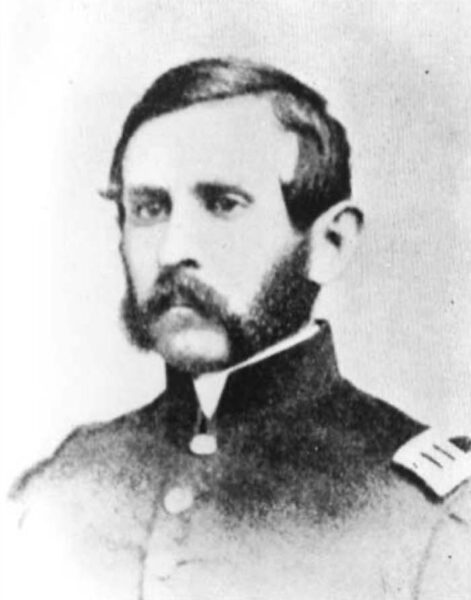
Although respected for his Civil War service, he was not familiar with Indian tactics. Fetterman continuously criticized his commanding officer’s defense strategy and bragged that with 80 men he would ride through the Sioux nation.
He would get his chance.
To The Battle
In mid November, Carrington gave Fetterman permission to conduct an ambush but the Indians didn’t fall for the ruse. Later, Fetterman was commanding an escort for a timber gathering party. An Indian appeared nearby, enticing Fetterman to pursue. The more experienced officer commanding the wood gathering group took cover behind the wagons instead, avoiding the mass of Indians out of sight beyond the hill where the individual first appeared.
Carrington’s superior, Gen Cooke, told Carrington to take the offensive. On Dec 6, reports came back that a wood party about 6 miles west of the fort was under attack. Fetterman was ordered to move west to assist the wood party; Carrington led a detachment north to circle around the Indians. The Indians retreated when the two forces joined up. Carrington was guided by Jim Bridger who commented: “The soldiers don’t know anything about fighting Indians”.
On Dec 20, Captains Fetterman and Brown were denied a request to attack a Sioux village about 50 miles away.
Red Cloud decided to attack Fort Kearney in a major operation before heavy snows caused the tribes to disperse for the winter. With about 1000 warriors, they laid a trap on either side of Lodge Trail Ridge, a few miles north of the fort but out of sight. The Sioux, Cheyenne, and Arapahoe split their forces on either side of the ridge and a group of Indians under Crazy Horse were chosen as the bait.
The nearest source of timber was about 5 miles NW of the fort. About 10AM, Carrington dispatched another wood party along with 90 soldiers to guard them. Shortly after the train left the fort, pickets on a hill nearby signaled the train was under attack. Fetterman was now a brevet Lt Colonel and was given command of the relief party. Two other Carrington critics, Lt Grummond and Captain Brown, along with two civilians joined Fetterman’s command, now totaling 81 men.
His chance had come.
Orders were that “under no circumstances was the relief party to pursue over Lodge Trail Ridge“. The orders were given twice; as the party was organized and when the party passed the fort gates. Grummond’s wife confirmed that the orders were given and heard by everyone present.
Fetterman immediately headed north for Lodge Pole Ridge rather than NW to the wood party under attack. It was assumed that Fetterman intended to circle around and attack the Indians from the rear. However, signals came that the wood party was no longer under attack as Fetterman disappeared out of site over the ridge line of Lodge Trail Ridge, chasing about 10 Indians acting as decoys who apparently mooned him.
Fetterman disobeyed orders; rather than go to the relief of the wood party, he chased the decoys north below the ridge. Mixed troops of cavalry and infantry got separated; the calvary unit leaving the infantry behind as they pursued the decoys. At the time the trap was sprung, the cavalry was about 1 mile ahead of the infantry.
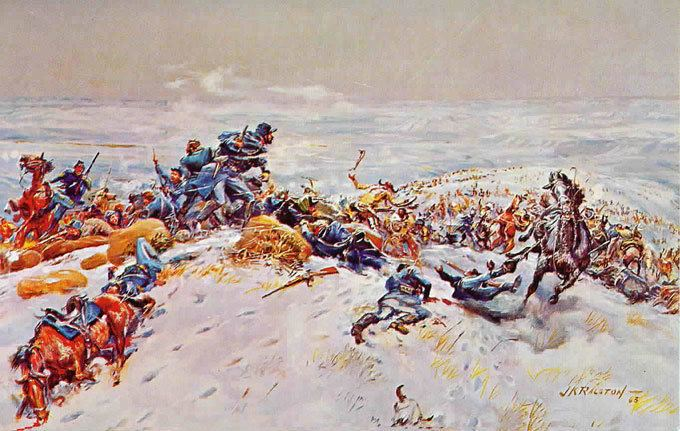
Heavy gunfire to the north was soon heard at the fort. Carrington sent 75 men on foot up the ridge under command of Capt Ten Eyck to see what was happening. Ten Eyck cautiously advanced up the ridge and from the top at about 12:24PM, he saw a large party of Indians in the valley below. Another 42 men were dispatched up the ridge and the taunting Indians slowly retreated.
All 81 men under Fetterman’s command were dead; stripped and mutilated bodies scattered just below the ridge. It had taken the Indians about 20 minutes to kill the infantry and another 20 to finish off the cavalry. Only 6 soldiers were killed by bullets. Fetterman and Brown suposedly committed suicide by shooting each other but some Indian accounts dispute that. Carrington reported: “eyes torn out and laid on rocks, noses and ears cut off, teeth chopped out, brains taken out and placed on rocks, hands and feet cut off, private parts severed.”
The last to die was the bugler who had used his bugle as a weapon until overcome. His was the only body not mutilated.
Estimates of Indian dead varied; as few as 10, perhaps as many as 160. The lower figure is considered more likely. Only the Custer fight 8 years later was more damaging.
Aftermath:
Carrington prepared the fort for a major attack. All excess ammo and explosives were placed in the magazine along with the women and children – to be blown up if the Indians broke through.
One can only imagine the fear permeating the fort’s inhabitants that long cold night …
In one of the more heroic and little known events of the Indian wars, a civilian, Portugee Phillips, took off in a deep winter night to carry a distress message to Fort Laramie, some 250 miles away. It took him 4 days riding through hostile territory through a blizzard. He arrived at Fort Laramie late in the evening on Christmas Day during the fort’s Christmas party
The bodies of those killed were buried in a common grave on December 26. Carrington was relieved of command and left the fort with the women and children on Jan 23 in weather reaching -38 degree to Fort Laramie. Carrington was absolved of blame but the public opinion had been settled. It was noted that Fort Laramie, a region of peace, was manned by 12 companies, while Foprt kearney, in war country, only had five.
The result of the Fetterman fight convinced the government to quit defending the Bozeman Trail and an 1868 treaty conceded the forts and Powder River to the Indians … which only lasted until 1876. The Indians destroyed the forts.
There remain 3 controversial items:
Carrington’s orders
Carrington claimed that Fetterman “was arrogant, insubordinate, and inexperienced in fighting Indians and that he gave Fetterman explicit orders not to venture beyond the summit of Lodge Trail Ridge.” The orders were given and emphasized several times with witnesses present.
Fetterman’s supporters claim Carrington and Fetterman had planned on an offensive movement and such orders were not given. Other than Carrington’s accusations, “there is no evidence indicating that Fetterman was anything but a professional officer and a perfect gentleman with a distinguished combat record.”
Lt Grummond, commanding cavalry
Carrington explicitly told Grummond to stick with Fetterman’s infantry. Grummond was an experienced combat officer but had also been court-martialed for drunkenness and abuse of civilians. he had obviously disobeyed Carrington’s orders; the cavalry unit was found about a mile away from Fetterman’s troops
Captain Ten Eyck
The captain was sent to the relief of Fetterman when large scale gunfire was heard at the fort. Ten Eyck was accused of being slow to Fetterman’s aid, taking a more roundabout path to the fighting. Although his actions were deemed appropriate, he was accused of cowardice and drunkenness and was “allowed” to retire from the army. There is no evidence Ten Eyck could have reached Fetterman in time to provide aid no matter the route and speed taken.
Fetterman, like Custer 8 years later, was considered a valiant hero and opinions to the contrary were not enjoyed. Walking the battleground – still an empty expanse, studying the history of other skirmishes in the area – the “Wagon Box fight”, the “Hayfield Fight”, and other goings on up and down the remnants of the Bozeman Trail, one can come to the conclusion that like Custer, Fetterman was overly impressed with himself, disdainful of his enemy, and willing to obey orders only when he agreed with him. It’s too bad he took so many down with him.
It’s been many a year since I travelled that country. I followed the actual trail where I could. Fort Kearney is now a state historical park and apparently has been somewhat reconstructed since I was last there.
Fort Reno, 1865-1868, built on a bluff above the Powder River, is marked by a monument but has reverted to prairie grassland. It was burned by Cheyenne in 1868, but again used as a supply base for 15 days in 1876. Only a few adobe walls existed of the old fort at that time. Those buried in the fort’s cemetery were disinterred in 1880 and moved to the Custer Battlefield National Cemetery. Debris is scattered around but nothing of significance remains.
Fort CF Smith was built in 1866 and was abandoned in 1868. The fort location is on private land within the Crow Reservation. “Melted” adobe walls remain, sufficient to outline the positions of structures. A monument exists but I’ve not been to the location
Sun Tzu said, “If you know the enemy and know yourself, you need not fear the result of a hundred battles. If you know yourself but not the enemy, for every victory gained you will also suffer a defeat. If you know neither the enemy nor yourself, you will succumb in every battle.”