
Mourning Doves
A ghostsniper comment
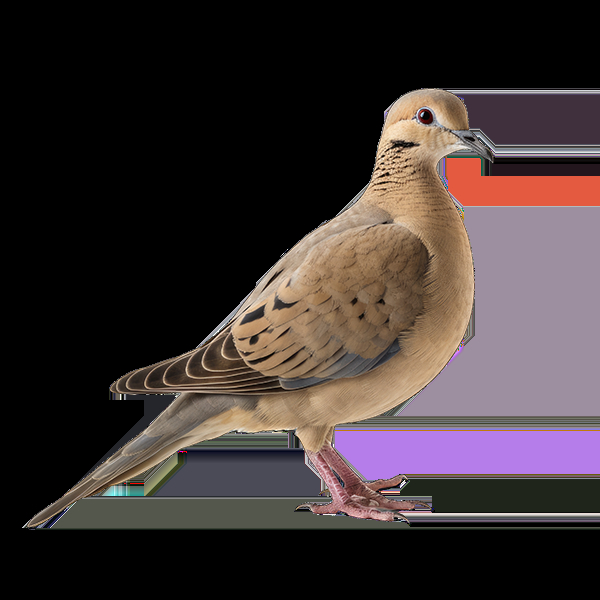
Watching the Mourning doves in the yard walking around, their heads constantly bobbing back and forth as they are in motion only stopping when they stop moving. How can they see, plainly, while their heads are bobbing?
Triangulation.
Simple geometry.
When the head is in the forward position they snap a picture, then a microsecond later when the head is in the rear position they take another pik. Instantly, their brain compares the 2 images and gives them the info they need.
Distance, height, color, etc. And much more. Their eyebals do not rotate in the sockets, the position of each is fixed, and from different sides of their heads. It can get complicated. To you. To them it is the only life they ever knew. From the day they are born.
To you it may seem a handicap, to them it just is. Imagine flying, through the branches and trees of a forest with eyes like that. They do it well. You, though, would crash and burn instantly.
You think your eyes see continuously while moving them around in their sockets but they do not. They are like a movie camera in that they take many pictures per second and stitch them together in your brain and make you think it is one continuous movie. Movie cameras take pictures rated at number of frames per second. Old skool TV was about 60 frames per second, and if, while viewing, you turned your head quickly from side to side you could catch a glimpse of this reality. Newer TV have a much higher frame rate.
While reading this, if you stop and focus on each letter in each word you will notice that in each position your eye is focused on you will only be able to see a few letters and the rest will sort of blur out. Then, seemingly fluidly, you will move your eyes to the next “group” of letters, that were formerly blurred and they will now be in focus and the previous letters will be blurred. There is no continuous focus. You can see this more clearly at night, with clear night vision.**
With each advancement of your seeing eyes they are doing what the doves eyes do. Sending a signal to your brain that then stitches all of the stops into a seemingly continuous movement. What your eyeball does while rotating in the socket is what takes the Mourning Dove an entire head movement to do.
Fascinating, no?
**If, in darkness, you look directly at something at a distance, it will seem to be in an unfocused cloud. This is because of a blind spot on the rear of the eye where the retina cord connects. (there is a technical term for this but it eludes me at the moment) Therefore, if you want to look at a thing in the dark you need to avert your focus a little to one side or the other. In a way, your peripheral vision is better than your direct vision.